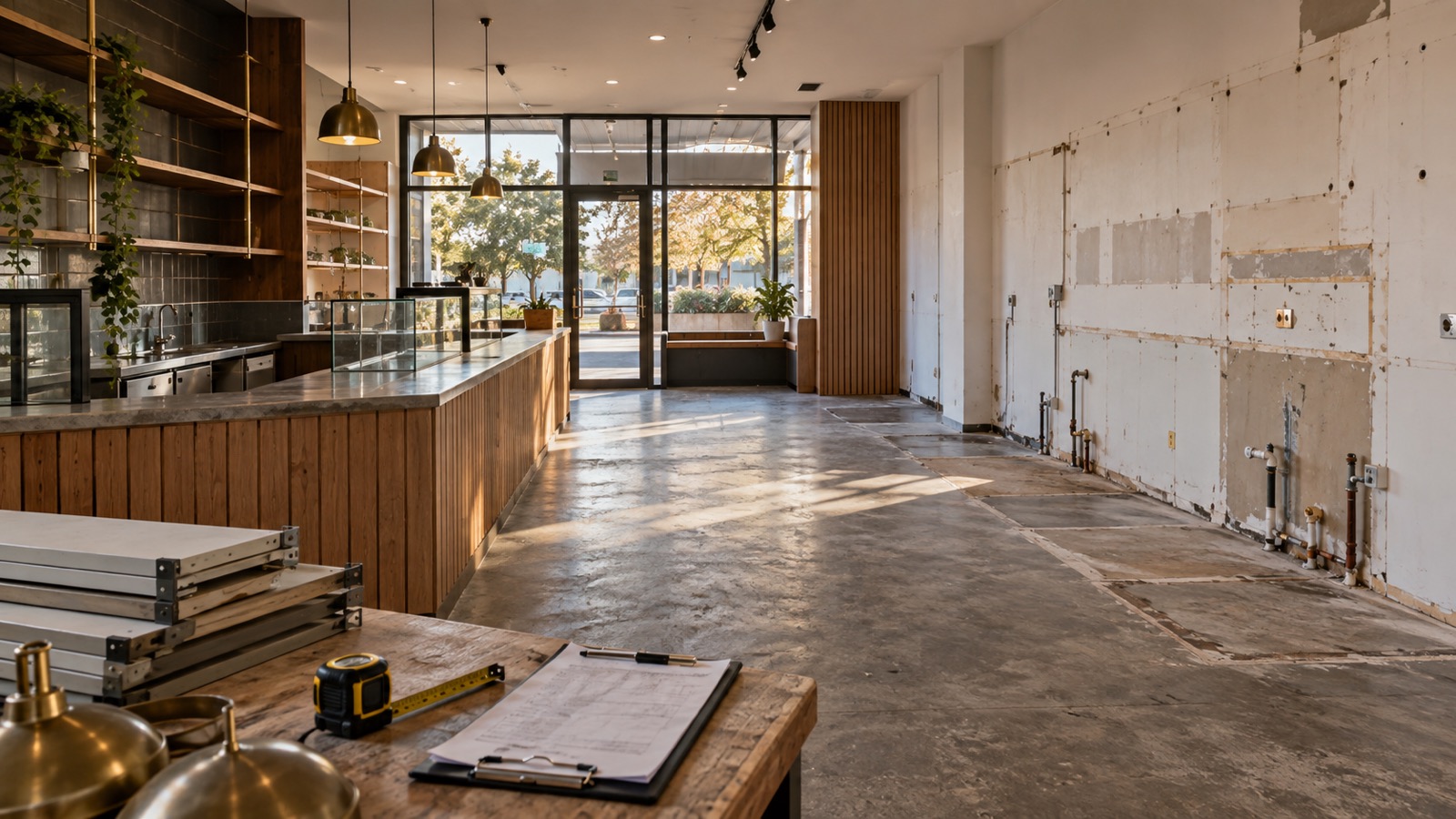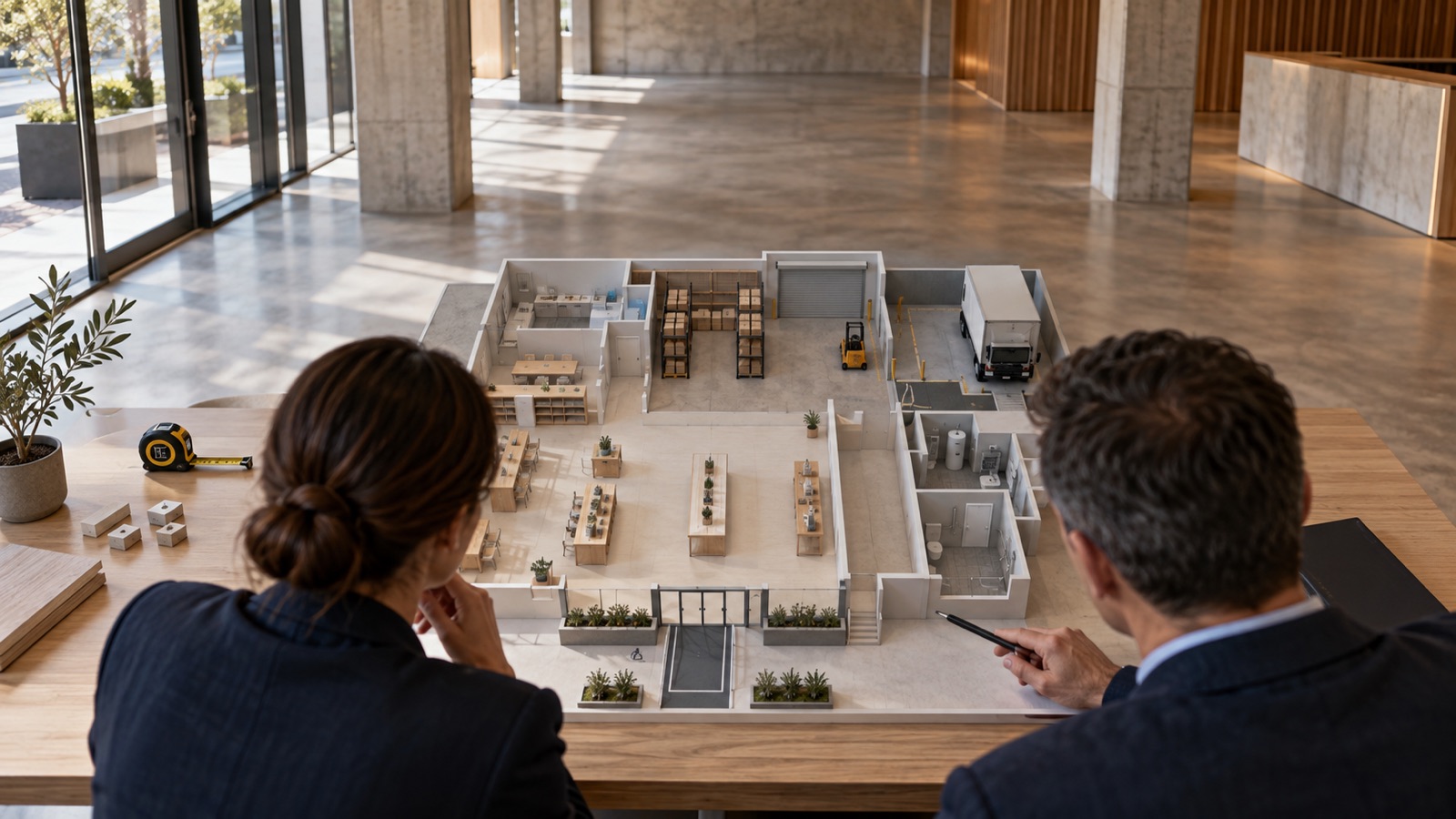
Premises are suitable for an acquisition only if they can lawfully and practically support the buyer’s intended operation at the required volume. The seller’s business may trade there today, yet the site may not accommodate the buyer’s planned hours, product mix, staffing, equipment, deliveries, customer experience or growth.
Define the operating model first, then test the property against it. Where a critical requirement cannot be verified, the buyer may need an approval condition, a revised operating plan, a cost and timing allowance—or a different transaction.
Start with an operating requirement, not the existing floor plan
Write a short premises brief based on how the business must work under your ownership. Classify each requirement as essential, adaptable or desirable:
- activities conducted on site, expected peak customer and staff numbers, trading hours and noise, odour or waste profile;
- work zones, customer areas, privacy, storage, amenities and circulation space;
- power, water, drainage, ventilation, gas, internet, temperature control and equipment loads;
- customer entry, accessibility, parking, public transport, visibility and wayfinding;
- supplier access, loading times, vehicle dimensions, waste collection and secure dispatch; and
- capacity required now, plus any credible expansion, service or channel change during the planned ownership period.
Australian Government guidance recommends defining location, size and layout, facilities, utilities, compliance and future-growth needs before choosing premises. It also directs businesses to check zoning and approvals with the relevant council (business.gov.au). An acquisition buyer can use the same discipline, but must test the already-operating site rather than assume continuity.
Verify lawful use for what you intend to do
Compare four descriptions: the seller’s actual activities, the buyer’s planned activities, the lease’s permitted use and the use authorised by planning and building records. Similar trading names do not establish that the activities, intensity or hours are the same.
Request the relevant development or planning consent, approved plans, occupation or occupancy evidence, building classification information and conditions affecting matters such as hours, patron numbers, deliveries, parking, signage, waste or outdoor areas. Verify material records with the issuing council, authority, certifier or surveyor.
The National Construction Code classifies a building or part according to the purpose for which it is designed, constructed or adapted. Different parts can have different classifications (ABCB, Part A6). The NCC takes legal effect through each state or territory’s framework, and the applicable version or local variation must be confirmed for the jurisdiction (ABCB, General NCC). A change in use, alterations or increased occupancy may therefore require specialist assessment rather than an assumption that the seller’s current setup is sufficient.
Map each necessary licence, permit or approval to the proposed operator, activity and site. The Australian Business Licence and Information Service covers requirements across Australian, state, territory and local government, but the relevant regulator should confirm whether an existing authority remains effective, can be transferred or requires a new application.
Test physical capacity and operating flow
A quoted floor area is not a capacity test. Use a measured plan and an observed peak period to trace how customers, staff, stock, equipment, deliveries and waste move through the site.
Check for bottlenecks and incompatible flows: customer queues crossing work areas, staff relying on shared access, stock moving through public space, deliveries obstructing entry, or storage displacing productive space. Confirm usable dimensions, ceiling heights, structural limits and the actual location and capacity of services with appropriately qualified advisers.
Accessibility is both an operational and compliance question. Inspect the route from boundary or parking to the entrance, doors, internal circulation, counters, amenities and emergency egress. The federal Disability (Access to Premises — Buildings) Standards 2010 contain the Access Code for Buildings and apply in defined circumstances. A building certifier, accessibility consultant or lawyer should determine how the standards and jurisdictional building law apply to the existing building and any proposed work.
Test the location for customers, staff and logistics
Do not treat the seller’s sales as proof that the location fits your plan. Separate demand generated by the premises from demand generated by the seller, brand, staff, online channels or pricing.
Inspect at relevant days and times. Record pedestrian and vehicle access, parking turnover, public transport, nearby demand generators, competing uses, delivery conditions, security and any planned local development. Compare the catchment with the buyer’s target customers and test staff travel at realistic shift times. Speak with logistics providers about vehicle access and collection windows where fulfilment is material.
Use evidence that matches the model: customer postcode or channel data, transaction timing, appointment patterns, delivery logs, staff travel information and direct observations. Handle personal information appropriately and use aggregated data where possible.
Build a premises suitability matrix
For each essential requirement, record the evidence, current position, change needed, responsible adviser, cost range, timing and decision status.
| Requirement | Evidence to verify | Decision question |
|---|---|---|
| Intended activities are lawful | Planning records, approved use, conditions, building classification and regulator confirmation | Can the buyer operate as planned from day one, and what approvals remain outstanding? |
| Peak operation fits | Measured plan, occupancy limits, observed workflow and equipment schedule | Can customers, staff and stock move safely without constraining throughput? |
| Services are adequate | Utility capacity, plans, bills, service records and technical inspection | Can the site support required equipment and peak demand reliably? |
| Access and logistics work | Site observations, parking/access rights, delivery logs and carrier feedback | Do customers, staff, suppliers and waste services have practical access at required times? |
| The site supports change | Scenario plan, authority advice and preliminary technical feasibility | Can the buyer’s credible expansion or channel shift occur within acceptable time and cost? |
Use four outcomes: verified, conditional, adaptable at quantified cost or unacceptable. Avoid converting “unknown” into “probably fine”.
Reflect the result in the acquisition decision
Premises findings can change the deal, not merely the property workstream. They may affect sustainable revenue, staffing, opening timing, working capital, capital expenditure and the period over which the purchase price can be recovered.
Ask the transaction lawyer and other advisers whether material issues should become conditions precedent, seller deliverables, access for further inspections, price or working-capital adjustments, a staged operational plan, or a right not to complete. An approval with uncertain timing or outcome should not be treated as complete merely because an application can be lodged.
Pause where the intended use cannot be confirmed, a critical service cannot be tested, peak capacity is materially below the forecast, access depends on informal practices or required changes have no credible approval, budget or programme.
When specialist advice is needed
A planning consultant or council may be needed to confirm permissible use and consent history. A building certifier or surveyor can assess classification, occupancy and proposed changes. Accessibility, fire-safety, engineering, environmental, traffic, acoustic or services specialists may be necessary depending on the operation. A commercial lawyer should connect those findings to the lease and acquisition documents, while an accountant should model the effect on maintainable earnings, cash needs and valuation.
Related reading
- Premises and lease considerations
- Taking Over the Seller’s Lease: Acquisition Questions to Resolve
- When Lease Terms Complicate a Business Purchase
- A Lease Due Diligence Checklist for Business Buyers
- Inherited Fit-Out and Make-Good Risks When Buying a Business
- Do Lease Incentives Distort the Earnings of a Business for Sale?
- An Existing Trading Location or New Premises: Acquisition Trade-Offs
- Why Lease Classification Matters When Buying a Business
Sources
- Choose your business location — Australian Government, reviewed 27 September 2026
- About — Australian Business Licence and Information Service, reviewed 27 September 2026
- Part A6 Building classification — Australian Building Codes Board, reviewed 27 September 2026
- General NCC — Australian Building Codes Board, reviewed 27 September 2026
- Disability (Access to Premises — Buildings) Standards 2010 — Federal Register of Legislation, reviewed 27 September 2026
Disclaimer
This article provides general information only. It does not constitute legal, tax, accounting, financial, credit, valuation or other professional advice. Circumstances differ. Obtain advice from appropriately qualified advisers before acting or entering a transaction.