
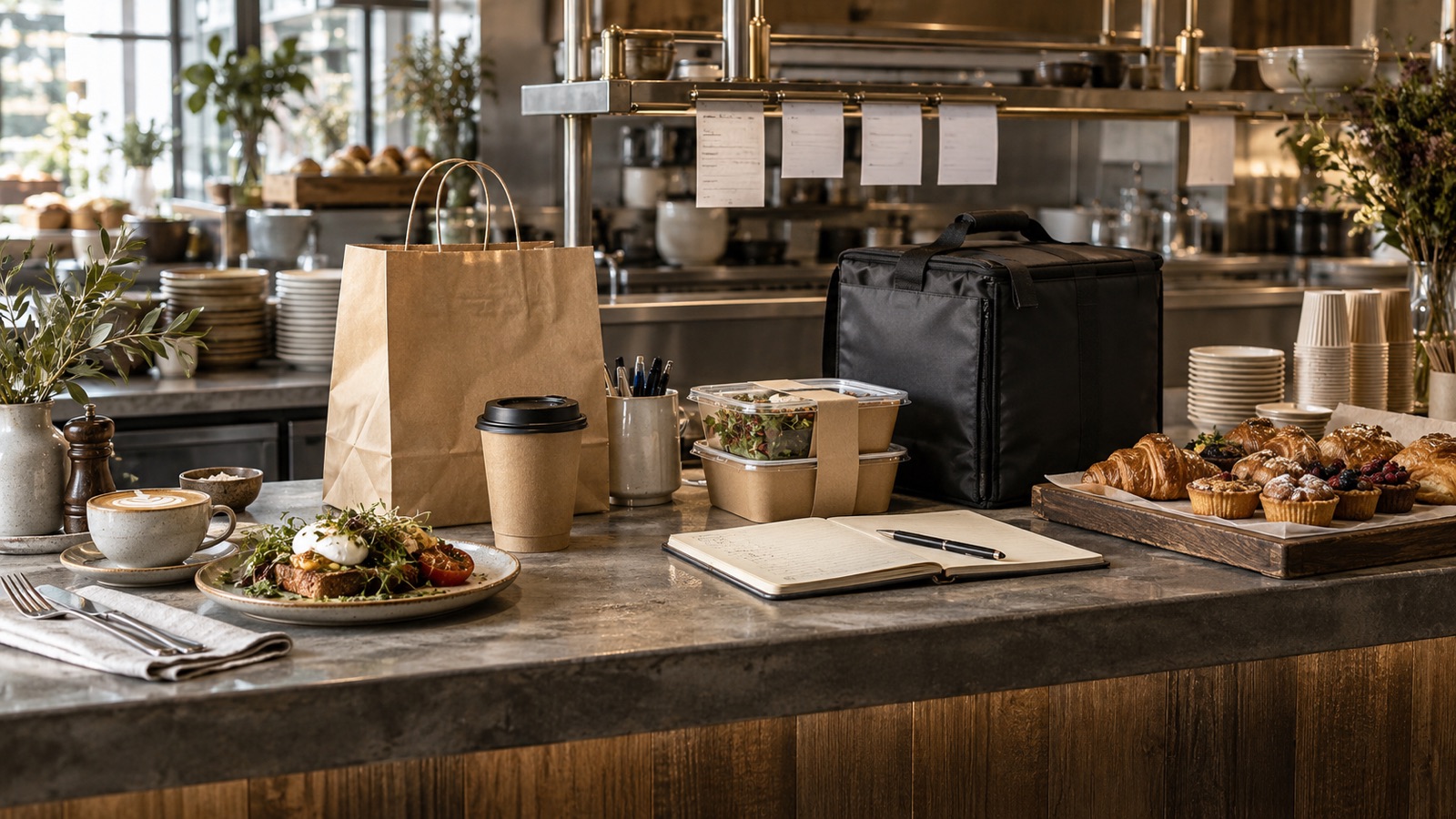
A café’s revenue mix matters because a dollar of dine-in sales does not have the same costs, operating demands or transfer risk as a dollar of takeaway, delivery or catering sales. A buyer should not treat the four channels as interchangeable turnover.
Rebuild each channel from source data, reconcile gross orders to cash received, and calculate a contribution after channel-specific costs. Then ask whether the people, premises, customer relationships and contracts that produce that revenue will remain after settlement.
What changes between the four channels
The mix can alter capacity, labour timing, food waste, packaging, commissions and customer ownership. A useful first comparison is:
| Channel | Main evidence | Costs and constraints to isolate | Continuity question |
|---|---|---|---|
| Dine-in | POS order type, table plan, covers and booking data | Front-of-house labour, crockery, cleaning, table turns and occupied space | Will the lease, seating capacity, trading permissions and service team continue? |
| Takeaway | POS tender and order source, counter or direct online reports | Packaging, queue pressure, collection errors and any direct-ordering fees | Does demand attach to the location and brand, and can peak production be maintained? |
| Delivery | Platform order exports, invoices, adjustments and settlement reports | Commission, promotions, refunds, packaging, remakes and courier waiting time | Can the account and commercial terms transfer, or must the buyer reapply? |
| Catering | Quotes, accepted orders, invoices, deposits and client history | Production labour, transport, equipment hire, wastage and debtor collection | Are repeat orders contractually supported or dependent on the seller’s relationships? |
Revenue share alone cannot identify the best channel. Dine-in may carry substantial service labour but support higher-margin add-ons. Delivery may add orders outside the café’s walk-in catchment but produce a much smaller net receipt. Catering may be attractive at scale yet lumpy, credit-based and dependent on a few organisers.
Reconstruct channel sales from native records
Request at least 24–36 consecutive months where available, with monthly and daily detail. Obtain native POS exports showing order source, tender, products, discounts, refunds, voids and timestamps. Match them to merchant statements, delivery-platform reports, direct-ordering reports, catering invoices, bank statements, the general ledger and lodged BAS records.
The ATO says a business must keep records of transactions relevant to its tax, super and registration affairs, including documents about income and expenses, as it starts, runs, changes, sells or closes (ATO). Those records provide a starting evidence set, but a buyer still needs to test completeness and reconcile systems created for different purposes.
For each channel, bridge:
- orders placed;
- cancellations, discounts, promotions, refunds and voids;
- completed gross sales on a consistent GST basis;
- merchant, platform or ordering-system fees and other deductions;
- net settlement or customer payment; and
- the amount and date received in the bank.
Do not classify a sale merely from its payment method. A card transaction could be dine-in, counter takeaway or a direct web order. Platform settlements can combine several trading days and arrive net of charges. Catering deposits may be received before the event, while an invoice may remain unpaid after it. Preserve both the service date and cash date.
GST presentation also needs consistent treatment. ATO guidance notes that food consumed on the premises and hot takeaway food are not GST-free under the ordinary food exemption, while classifications for other food and beverages vary (ATO). Have a tax adviser confirm the target’s classifications; do not compare one channel inclusive of GST with another excluding it.
Calculate contribution, not just turnover
Build a monthly channel schedule using the café’s actual terms and recipes. Start with net sales excluding GST on the basis confirmed by the buyer’s adviser. Deduct ingredients and consumables, then costs caused specifically by that channel: platform commissions, channel-funded discounts, packaging, payment fees, delivery errors, catering transport and incremental labour.
Keep common occupancy, management and equipment costs separate initially. The purpose is to see what each channel contributes before shared overhead, not to manufacture false precision by allocating rent using an arbitrary percentage.
Hypothetical example: a café records $40,000 of delivery orders in a month. It then records $2,000 of customer promotions funded by the café, $800 of refunds, $9,000 of platform and processing charges, $2,200 of delivery packaging, $11,000 of ingredients and $4,000 of incremental kitchen labour. The remaining $11,000 is a contribution before shared overhead and tax, not profit. The figures illustrate the method only and are not an industry benchmark.
Compare the result across seasons and dayparts. A delivery channel that appears profitable over a month may overload the kitchen during the same breakfast window that serves higher-contribution dine-in customers. Conversely, controlled takeaway volume may use spare production capacity without requiring more seating.
Test operational capacity and food-safety demands
Map orders in 15- or 30-minute intervals against rosters, docket times, refunds, complaints and waste. Investigate whether one channel delays another, requires a separate menu or uses equipment near capacity. Observe more than one trading period and include a busy service.
Delivery is not merely a marketing channel. Food Standards Australia New Zealand says Standard 3.2.2 includes requirements for food handling, temperature control and food transport, and businesses should check whether approvals are required for delivery operations (FSANZ). Catering can add advance preparation, transport and off-site service risks. Ask for procedures, temperature records, allergen controls, complaints and incident logs relevant to each channel, then obtain food-safety advice for the applicable state or territory.
Check whether the channel survives the acquisition
Obtain every platform, ordering, catering, loyalty and merchant agreement. Record the contracting entity, term, fees, exclusivity, data access, refund allocation, termination rights, change-of-control provisions and any assignment or consent process. The ACCC explains that written contract terms define parties’ rights and responsibilities, and notes that unfair-term protections can apply to qualifying standard-form small-business contracts (ACCC). This does not make an existing agreement automatically transferable or guarantee the buyer the seller’s pricing.
Platform terms deserve direct verification. In a 2019 enforcement example, the ACCC said Uber Eats agreed to change restaurant contract terms concerning responsibility and refunds; the example is historical, but it shows why buyers should inspect the current agreement rather than assume who bears a delivery failure (ACCC).
For catering, separate contracted future work from a seller’s pipeline. Confirm deposits, cancellation rights, deferred revenue, outstanding delivery obligations and who owns the client relationship. Test concentration by customer, referrer and venue. A spreadsheet of enquiries is not contracted revenue.
A buyer’s channel-mix decision framework
Rate each channel against five questions:
- Evidence: Can order data be reconciled to invoices, settlements, bank receipts and the ledger?
- Economics: What remains after direct food, labour, packaging, commission, promotion, refund and fulfilment costs?
- Capacity: Does the channel use spare capacity or displace stronger trade at peak times?
- Durability: Is demand recurring across periods, or concentrated in a promotion, customer or temporary condition?
- Transferability: Will contracts, accounts, data, reviews, staff capability and customer relationships continue on acceptable terms?
Unreconciled sales, missing platform deductions or non-transferable arrangements should not be valued as though they are proven maintainable earnings. The response may be a lower forecast, a transaction condition, a price adjustment or a decision not to proceed.
Questions buyers commonly ask
Is delivery revenue less valuable than dine-in revenue?
Not automatically. Value depends on supported contribution, capacity use, stability and transferable terms. Compare actual channel economics rather than applying a generic discount.
Should catering orders in the pipeline be included in forecast revenue?
Only with appropriate probability and evidence. Distinguish enquiries, accepted quotes, paid deposits and binding obligations, and allow for fulfilment costs, cancellations and customer concentration.
Who should review the channel evidence?
An accountant can test reconciliations and contribution schedules; a tax adviser can review GST treatment; a lawyer can examine sale and third-party contracts; and an appropriate food-safety adviser can assess operational requirements. Their work should use the buyer’s proposed entity and post-settlement operating model.
Related reading
- Café acquisitions
- Buying a Café in Australia: A Buyer’s Guide
- How to Verify Café Sales Using POS Records, Bank Deposits and Tax Records
- Customer Numbers, Average Spend and Trading Hours: Testing Café Sales Assumptions
- Food Costs, Waste and Menu Margins: What Café Buyers Should Investigate
Sources
- Overview of record-keeping rules for business — Australian Taxation Office, reviewed 2026-10-03
- Details of the GST status of major food and beverage product lines — Australian Taxation Office, reviewed 2026-10-03
- Contracts — Australian Competition and Consumer Commission, reviewed 2026-10-03
- Uber Eats amends its contracts — Australian Competition and Consumer Commission, reviewed 2026-10-03
- Food delivery — Food Standards Australia New Zealand, reviewed 2026-10-03
Disclaimer
This article provides general information only. It does not constitute legal, tax, accounting, financial, credit, valuation or other professional advice. Circumstances differ. Obtain advice from appropriately qualified advisers before acting or entering a transaction.

