
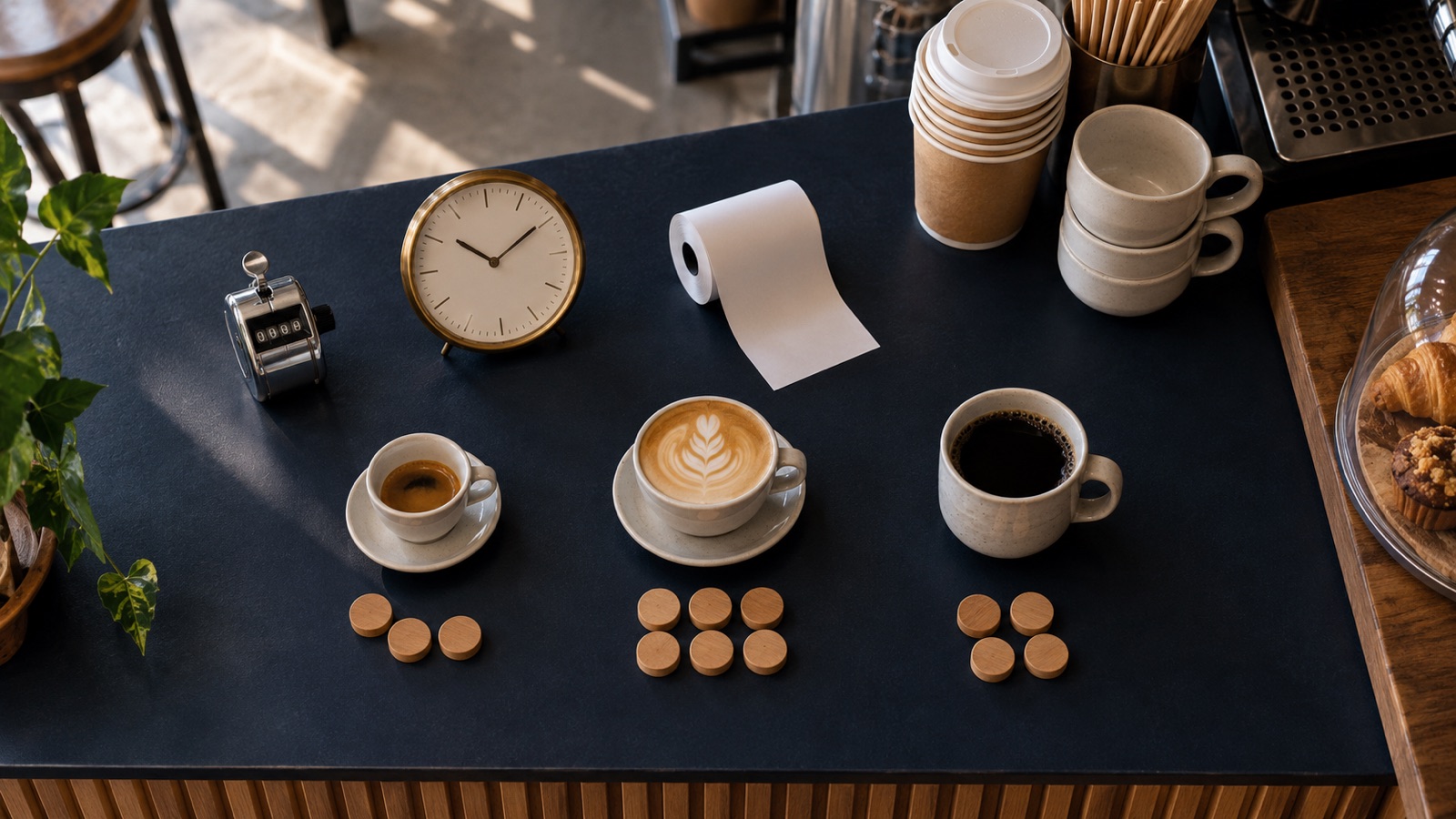
A café’s claimed sales should be capable of being rebuilt from a plausible number of transactions, a supportable average spend and the hours in which trade actually occurred. None of those measures proves revenue alone. Together—and reconciled to point-of-sale (POS), payment and accounting evidence—they can expose whether the seller’s headline turnover fits the operation a buyer can see.
The key is to analyse the business by day and daypart, not accept one weekly average. Breakfast, lunch and afternoon trade can have different customer volumes, ticket values, service speeds and channel mixes. Averages that conceal those differences can make a weak period look stronger or make peak trade appear repeatable across every hour.
Start with the sales equation—then challenge every input
A useful first model is:
Transactions × average transaction value = recorded sales.
That is an arithmetic check, not a conclusion. One POS transaction may cover one takeaway coffee, a table of four, a delivery order or a catering invoice. Customer numbers, covers and transactions are therefore different measures. Ask the seller to define which measure each report uses and keep that definition consistent.
Request at least 12 months of daily POS exports and, where available, 24 months to reveal seasonality. The data should include transaction timestamps, gross and net sales, discounts, refunds, voids, payment method, sales channel, order type, items and staff login. Obtain rostered and actual opening and closing records, delivery-platform reports, booking or table data, merchant settlement reports and bank deposits for the same dates.
This request is consistent with the underlying record environment. The ATO says businesses are legally required to keep records of transactions relating to their tax, superannuation and registration affairs (ATO). Its record-keeping guidance also says cash and EFTPOS sales should be reconciled regularly and that estimates should not be used to prepare tax returns or business activity statements (ATO). For a buyer, clean source records are evidence to test—not a reason to skip reconciliation.
Build a daily and daypart matrix
Export the source data rather than relying on screenshots or a seller-prepared summary. For each day, calculate:
- transaction count and, if captured reliably, dine-in covers;
- net sales after refunds and discounts;
- average transaction value and average spend per cover;
- sales and transactions by hour or practical daypart;
- dine-in, takeaway, delivery and catering contribution;
- cash, card, platform and other payment totals; and
- scheduled opening hours, first transaction and last transaction.
Use medians as well as averages. A few unusually strong Saturdays, public events or large catering orders can lift the average while the typical day is materially lower. Compare like with like: Mondays with Mondays, school-holiday periods with comparable periods, and wet-weather weeks with the relevant context.
The Australian Government’s accommodation and food services guidance notes that demand can depend on location, local population, tourism, time of year, weather and economic conditions. It also identifies long or irregular trading hours as common in the industry (business.gov.au). Those factors are prompts for analysis, not explanations to accept without dated evidence.
Test customer numbers and transaction integrity
Check whether reported counts are generated automatically or entered manually. Trace a sample of busy and quiet days from POS close reports to merchant settlements, delivery-platform records, cash deposits and the accounting ledger. Investigate missing sequence numbers, reopened bills, post-close edits, unusually high voids, large discounts, split or merged bills and repeated use of generic products.
Then translate transactions into operational activity. If the seller describes 300 customers but the POS shows 190 tickets, ask how group orders, tables and takeaway bundles are counted. Use item quantities, table records or short periods of direct observation to estimate the relationship. Do not simply rename tickets as customers.
Compare counts with consumable usage only as a reasonableness test. Coffee-bean usage, takeaway cups, milk and bread can support or challenge the volume story, but wastage, staff consumption, recipes, retail bean sales and stock movements must be allowed for. A consumption estimate is not a substitute for sales records.
Recalculate average spend properly
Clarify whether the seller’s “average spend” is gross sales per ticket, net sales per ticket, sales per customer or sales per table. Recalculate it consistently after refunds and discounts. Separate GST-inclusive and GST-exclusive figures where relevant to the financial model, and do not combine platform gross order values with net POS sales.
Segment the result. A breakfast table may buy meals and drinks; an afternoon transaction may be one coffee; a delivery ticket may be larger but attract platform deductions. Calculate average values by daypart, channel, weekday and product group. Compare changes with dated menu prices and discount campaigns. Rising average spend caused only by price increases does not demonstrate rising customer demand.
Use the ATO’s Small Business Benchmarks only as external context. Industry ratios can help identify questions, but they cannot prove a particular café’s transactions, customer counts or achievable sales.
Test claimed hours against actual hours and capacity
Advertised hours are not necessarily hours traded. Compare website and platform listings with POS first-and-last-sale times, alarm or access logs, staff clock-ons, delivery availability and direct observation. Ask about temporary closures, shortened winter hours, equipment breakdowns and owner-only preparation time.
Also confirm that the buyer may continue the assumed hours. State governments set trading-hour rules, while local approvals or permits may affect particular operations, according to business.gov.au. Review the lease, development consent, outdoor-dining approval, liquor conditions and centre rules with appropriate advisers rather than assuming the seller’s current practice is authorised or transferable.
Capacity provides another sense check. Estimate usable seats, table turns, takeaway throughput, coffee-machine and kitchen bottlenecks, staffing by hour and queue tolerance. Peak sales may be possible for 30 minutes yet unsustainable for an entire day. Observe at least several representative sessions, including a claimed peak and a quiet period, without treating one visit as a statistical sample.
Work a clearly labelled hypothetical example
Suppose a seller claims $14,000 weekly sales from 1,000 customers at $14 average spend. The POS instead shows 760 weekly transactions. That does not disprove the claim: some transactions may include several customers. It does mean the buyer should establish the average customers per transaction and reconcile the $14,000 to channel and payment records.
If Saturday contributes $4,000 during four strong hours, do not spread that rate across every advertised hour. Rebuild each daypart, allow for closures and channel-specific spend, then test whether seating, staffing and production capacity could deliver the implied orders. This example is illustrative only; it is not a performance benchmark or valuation method.
Use a buyer’s decision grid
| Question | Supportive evidence | Reason to pause |
|---|---|---|
| Are volumes real? | POS counts reconcile across payment and operational records | Definitions change or source exports are unavailable |
| Is average spend durable? | Net values are consistent by channel and daypart | A few catering orders or price rises drive the result |
| Were the hours actually traded? | First/last sales, rosters and access evidence align | Advertised hours exceed observed operation |
| Is the volume operationally possible? | Seats, turns, staff and equipment support throughput | Implied orders exceed credible capacity |
| Can the buyer repeat it? | Hours, approvals, people and channel access can continue | Performance depends on seller-only effort or uncertain permissions |
A failed check may justify more evidence, a condition, a revised operating forecast or a decision not to proceed. An accountant can test the financial reconstruction; a lawyer and relevant authorities can address lease, approval and trading constraints; and hospitality or equipment specialists can assess practical capacity.
Related reading
- Café acquisitions
- Buying a Café in Australia: A Buyer’s Guide
- How to Verify Café Sales Using POS Records, Bank Deposits and Tax Records
- Café Revenue Mix: Dine-In, Takeaway, Delivery and Catering
Sources
- Overview of record-keeping rules for business — Australian Taxation Office, reviewed 2026-10-03
- Record-keeping tips — Australian Taxation Office, reviewed 2026-10-03
- Accommodation and food services industry — Australian Government, reviewed 2026-10-03
- Small Business Benchmarks — Australian Taxation Office, reviewed 2026-10-03
Disclaimer
This article provides general information only. It does not constitute legal, tax, accounting, financial, credit, valuation or other professional advice. Circumstances differ. Obtain advice from appropriately qualified advisers before acting or entering a transaction.

