
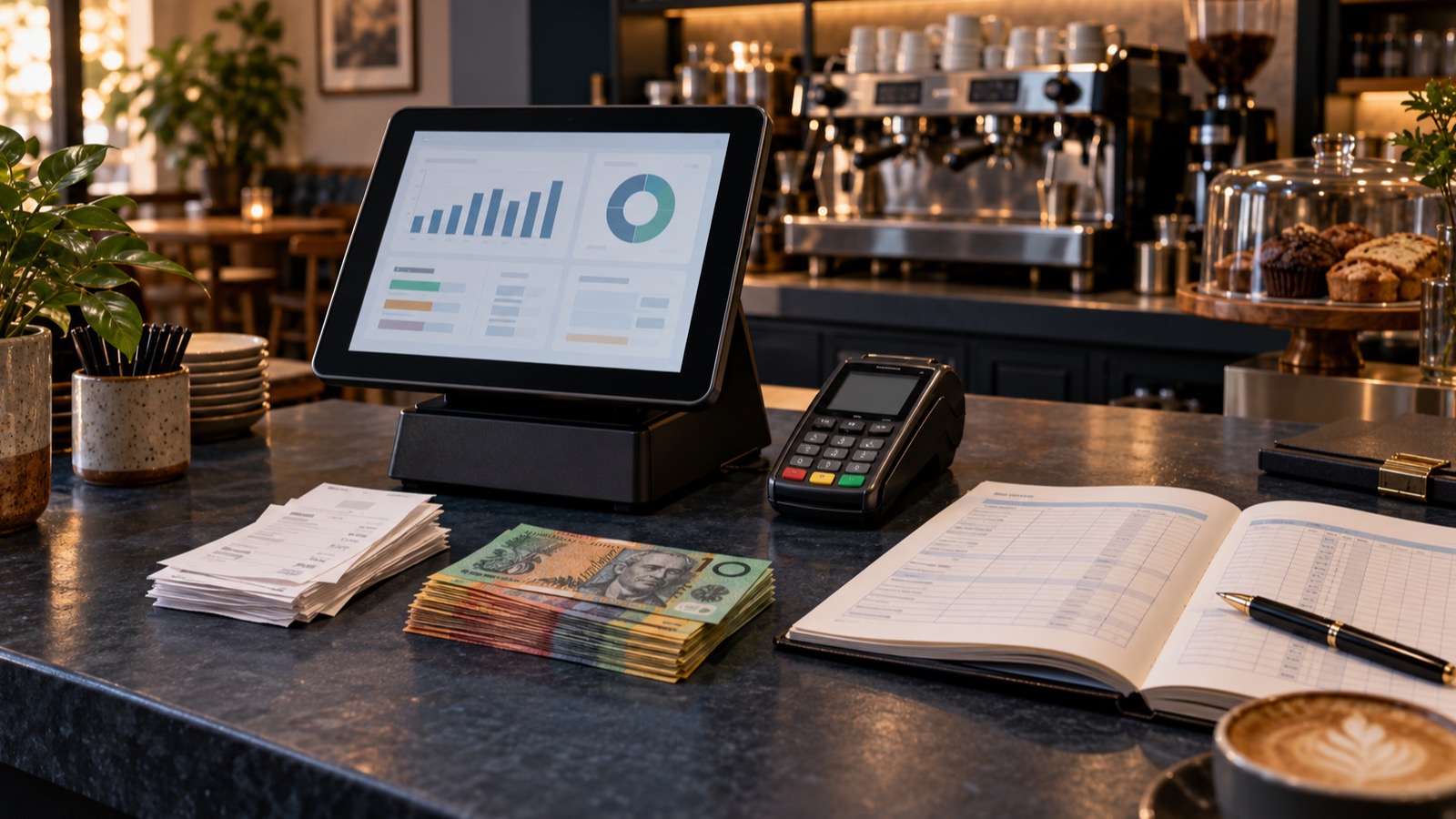
No single report proves a café’s sales. A buyer should reconcile transaction-level point-of-sale (POS) records to merchant settlements and cash deposits, then bridge those figures to the accounting ledger and lodged tax records. Differences can be legitimate, but each should be quantified, timed and supported.
The objective is not to make several seller-produced totals agree. It is to trace sales through systems created for different purposes, preferably using native data obtained independently. Consistent evidence increases confidence; unexplained gaps should change the buyer’s assumptions, transaction conditions or willingness to proceed.
Why three records rarely match automatically
POS sales, bank receipts and tax figures measure different stages. A POS system records orders and tenders when entered. A bank account records settlement after card fees, platform deductions and timing delays, plus whatever cash is banked. A business activity statement (BAS) reports tax information for a defined period using the business’s applicable GST method.
The ATO says businesses must keep records of transactions relevant to their tax, GST and super affairs, including income and sales records such as tax invoices, receipt books, cash-register tapes and records of cash and digital sales (ATO). That compliance requirement is useful to a buyer, but the existence of records does not establish that they are complete or that the acquisition forecast is sound.
Common reconciling items include:
- card transactions settling one or more days after the sale;
- merchant fees deducted before a net settlement reaches the bank;
- delivery-platform sales paid net of commission, promotions or refunds;
- cash retained as float, used for recorded expenses or drawings, or banked later;
- refunds, voids, discounts, tips, gift-card sales and redemptions;
- GST-inclusive versus GST-exclusive reports and period cut-offs; and
- non-trading bank credits or BAS amounts not attributable to ordinary café sales.
Request native records, not a sales summary
Ask for 24–36 months of source data where available, covering complete financial years and the most recent trading period. Obtain POS exports in a usable format rather than screenshots alone. The request should include daily totals, transaction timestamps, order numbers, tender type, GST treatment, products or categories, discounts, refunds, voids, deleted transactions, open orders, user IDs, training-mode activity and the audit or change log.
Also request merchant-acquirer statements, bank statements for every account receiving café income, cash-banking records, delivery and online-ordering statements, the sales ledger, general ledger, lodged BAS copies, annual income tax returns and financial statements. Ask the seller’s accountant to identify the reports used to prepare each BAS and year-end accounts. Access should be authorised and proportionate; a buyer’s accountant should handle sensitive tax material through a controlled data room.
Test whether the export is truly native. Record when it was generated, which locations and channels it includes, whether historical transactions can be edited, and whether the system changed during the review period. A live, read-only walkthrough can demonstrate report settings and allow selected days to be regenerated.
Build the reconciliation in layers
1. Reconstruct sales from the POS
Start by month, then test selected weeks and days. Bridge gross orders to discounts, voids and refunds, then to completed net sales. Separate cash, card, delivery platform, gift card and other tenders. Check that transaction counts, average order value and GST categories roll into the reported totals.
Inspect exceptions rather than sampling only busy days. Review missing receipt numbers, unusual after-hours entries, repeated round-dollar sales, large discounts, excessive voids, negative transactions and changes made by administrator accounts. The ATO warns that electronic sales suppression tools can delete, resequence, reduce or misrepresent transactions and produce false records (ATO). An anomaly is not proof of misconduct, but missing audit trails or unexplained database changes warrant specialist review.
2. Trace tenders to money received
Match card totals to each merchant and platform settlement before comparing the net amount with the bank. Create a bridge for fees, chargebacks, refunds, withheld balances and settlement cut-off differences. Confirm that all merchant IDs and payout accounts are included.
For cash, reconcile daily POS cash tenders to the till count, float movements, documented cash expenses and the amount banked. The ATO’s banking guidance recommends regular reconciliation and says daily cash sales should balance to net cash sales banked after accounting for matters such as cash expenses, wages, drawings and float (ATO). Cash deposited alone cannot prove gross cash sales because the seller controls what is banked.
3. Bridge the ledger to lodged tax records
Reconcile POS-derived sales and banked receipts to the sales ledger, then bridge ledger revenue to each lodged BAS and the annual accounts. At G1, the BAS may include taxable, GST-free and input-taxed sales and can contain amounts beyond ordinary café takings (ATO). Identify the reporting basis, GST coding, journals, year-end adjustments, asset sales and other reconciling items rather than assuming G1 equals café revenue.
Have a registered tax agent or accountant review tax classifications and obtain source documents through an authorised process. A BAS or tax return is corroboration, not an audit opinion on sales accuracy.
Add operational cross-checks
Use independent operating data to test whether verified sales are plausible. Compare customer counts and average spend with rostered hours, trading days and observed capacity. Reconcile product sales to coffee-bean, milk, cup and key food purchases after allowing for stock movements, staff consumption, spoilage and waste. Compare delivery orders with platform reports and check whether menu prices in the POS match the periods claimed.
ATO coffee-shop benchmarks compare cost of sales and total expenses with turnover for businesses in turnover bands (ATO). Benchmarks can prompt questions, but they do not verify this café’s sales or prove that an outlier is wrong. Concept, product mix, location and operating model can produce legitimate differences.
A worked reconciliation example
Hypothetical example: the POS shows $120,000 of completed monthly sales: $90,000 card, $18,000 delivery and $12,000 cash. The bank shows $87,300 from the card acquirer, $13,900 from delivery platforms and $9,000 of cash deposits.
The buyer should not call the $9,800 difference missing revenue. First obtain statements showing, for example, $2,700 of card fees and adjustments, $4,100 of delivery commission and refunds, and a cash bridge for the remaining $3,000. If only $1,000 is supported as float and recorded petty cash, the unexplained $2,000 remains a diligence issue. Repeat this analysis across multiple periods; do not extrapolate from one favourable month.
Decision points before relying on the sales figure
Pause and resolve the position if:
- the seller supplies only PDFs, screenshots or management summaries;
- transaction exports do not reproduce POS dashboard totals;
- merchant accounts, delivery channels or bank accounts are omitted;
- voids, refunds, cash shortages or manual journals lack support;
- BAS and annual accounts cannot be bridged to the underlying ledger;
- records were reconstructed only after the sale process began; or
- recent sales growth coincides with changed hours, ownership inputs or unsustainable promotions.
Unresolved differences may justify more evidence, a condition precedent, revised normalised earnings, a price or structure adjustment, or withdrawal. The appropriate response should be designed with accounting, tax and legal advisers; sales verification is not a substitute for a formal audit or valuation.
Related reading
- Café acquisitions
- Buying a Café in Australia: A Buyer’s Guide
- Café Due Diligence: Documents to Request Before Making a Commitment
- Cash Sales in a Café Acquisition: What Can Actually Be Verified?
Sources
- Overview of record-keeping rules for business — Australian Taxation Office, reviewed 2026-10-03
- Banking records – business — Australian Taxation Office, reviewed 2026-10-03
- Completing your BAS for GST — Australian Taxation Office, reviewed 2026-10-03
- Coffee shops benchmark — Australian Taxation Office, reviewed 2026-10-03
- Electronic sales suppression tools (ESSTs) are on our radar — Australian Taxation Office, reviewed 2026-10-03
Disclaimer
This article provides general information only. It does not constitute legal, tax, accounting, financial, credit, valuation or other professional advice. Circumstances differ. Obtain advice from appropriately qualified advisers before acting or entering a transaction.

