
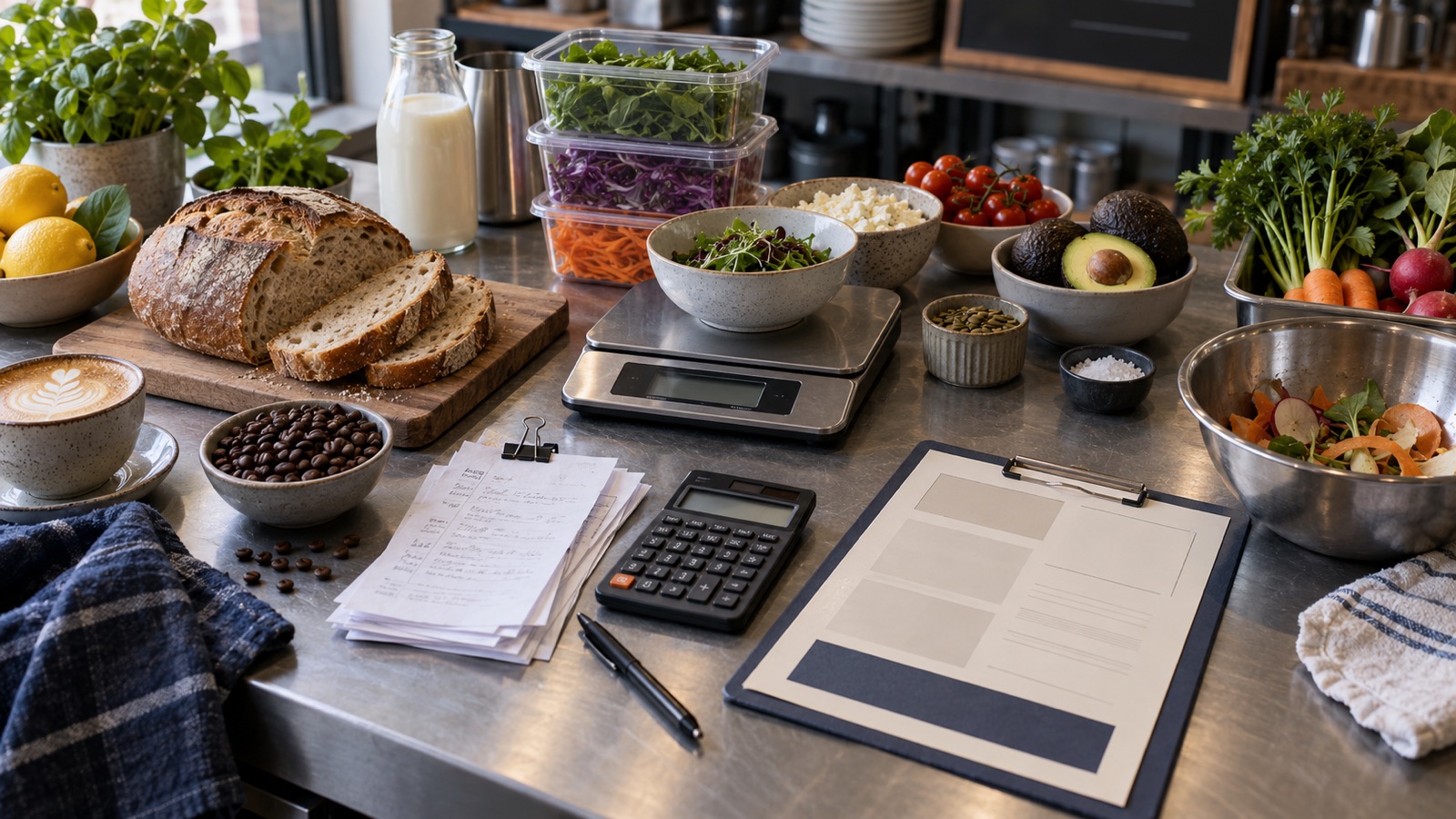
A café’s reported food-cost percentage is a starting point, not proof of sustainable margin. A buyer should rebuild the cost of representative menu items from current supplier invoices and realistic usable yields, then reconcile total purchases to opening stock, closing stock, recorded waste and actual sales mix.
The central question is not whether a theoretical recipe looks profitable. It is whether the café consistently converts purchased ingredients into saleable portions at the prices, volumes and waste levels assumed. That requires evidence from the kitchen, POS, supplier accounts and stock records—not a single profit-and-loss line.
Start with the right measures
Keep three measures separate:
- Recipe cost is the quantity of each ingredient used in one saleable portion multiplied by its current purchase cost, adjusted for pack size and usable yield.
- Food cost of sales reconciles ingredients consumed across a period: opening stock plus purchases, less closing stock, with consistent treatment of transfers and other adjustments.
- Contribution margin is the selling price, measured on a consistent GST basis, less costs that vary directly with the sale. At minimum this may include ingredients and packaging; delivery commissions or transaction charges may also be relevant when comparing channels.
Contribution margin is not net profit. It does not by itself cover wages, rent, utilities, cleaning, repairs, administration or owner remuneration. Nor should a buyer assume a high percentage margin is best: a lower-percentage item with strong volume and limited preparation may contribute more dollars than an intricate item that sells rarely.
Rebuild recipe costs from usable yield
Request the current menu, recipe cards, portion specifications, prep sheets, supplier invoices, credit notes and price lists. For a sample spanning high-volume, high-price and high-waste items, cost every component—including garnishes, cooking oil, condiments, milk alternatives and takeaway packaging.
Use the cost of the usable quantity, not merely the supplier pack. A 10-kilogram carton does not produce 10 kilograms of plated ingredient if trimming, peeling, bone, cooking shrinkage or spoilage removes part of it. Test yields by observing a normal preparation batch and weighing the purchased, prepared and discarded quantities. Standard scoops, scales and container sizes help determine whether the recipe on paper matches service.
Price testing also needs dates. Match recipes to invoices from the same period, note rebates and freight, and identify ingredients bought through non-standard or related-party suppliers. A seller’s historical cost can understate the buyer’s position if a discount, informal supply arrangement or favourable term will not continue.
Where menu prices or costs mix GST-inclusive and GST-exclusive figures, ask the accountant to restate them consistently. The ATO’s GST food and beverage search tool cautions that its product search should not be used for dine-in or hot takeaway items, which are taxable. Product and supply circumstances can differ, so buyers should not infer GST treatment from a menu label alone.
Reconcile purchases to what the café sold
Build a monthly purchase-to-usage schedule for at least a representative trading period:
Opening stock + purchases − closing stock = apparent ingredient usage
Then bridge apparent usage to POS menu quantities using recipe bills of materials. Separate waste, staff meals, complimentary items, owner consumption, catering transfers, recipe testing and unexplained variance. Supplier returns and credit notes should reduce purchases in the correct period.
Start with a few ingredients that are both material and traceable—coffee beans, milk, eggs, bacon, avocado or takeaway cups may be useful depending on the menu. For each, compare theoretical usage from POS quantities with actual usage from stock and purchases. A variance may reflect portion creep, substitutions, missing recipes, inaccurate counts, unrecorded sales or waste; it is a question to resolve, not automatic evidence of misconduct.
The ATO says business records should explain relevant transactions and be retained in a form that can be accessed and understood (ATO). Its stock-record guidance also says stocktake records should identify articles and values, who performed the count, how and when it was done, and the valuation basis (ATO). For acquisition analysis, those records are useful only if count sheets, invoice dates and ledger postings can be linked.
Find waste that the accounts may hide
Waste is not one number. Ask for separate records of preparation trim, overproduction, spoilage, expired stock, damaged deliveries, incorrect orders, returned plates, staff meals and theft or unexplained loss. Compare waste by item, reason, shift and daypart with manager notes and stock adjustments.
Inspect storage capacity and routines as well as logs. Food Standards Australia New Zealand says food businesses must store food so it remains safe and suitable; its guidance includes keeping potentially hazardous food at 5°C or colder, following storage instructions and discarding stock past its use-by date (FSANZ). Poor refrigeration, crowded cool rooms, weak date rotation or oversized prep batches can therefore create both compliance exposure and recurring economic loss.
A short observation period can be revealing. Watch portioning and prep during ordinary service, count high-risk stock at opening and close, and compare the result with POS sales and waste logs. Avoid treating a seller-curated quiet day as representative.
Map sales mix to menu contribution
Export item-level POS sales by week, channel and time of day. For each meaningful item, calculate contribution dollars per sale and total contribution over the period. Then group items by volume and contribution:
- high volume, strong contribution: protect availability and consistency;
- high volume, weak contribution: test price, portion and supplier sensitivity;
- low volume, strong contribution: consider whether visibility or complexity limits sales; and
- low volume, weak contribution: challenge the item’s place on the menu.
Include channel-specific packaging, promotions and platform deductions when those costs vary with the order. Also test whether removing a low-margin item could reduce sales of linked drinks or sides. Menu decisions are behavioural as well as arithmetic.
The ATO publishes a coffee-shop benchmark in which cost of sales to turnover is a key ratio (ATO). Treat that as a reasonableness prompt, not a target or valuation rule. Concept, menu, location and channel mix can produce legitimate differences, while a seemingly normal aggregate ratio can conceal poorly costed individual items.
A buyer’s decision framework
Before relying on the seller’s gross margin, ask whether:
- recipe quantities have been observed and costed at current, transferable prices;
- usable yields and normal preparation losses are measured rather than assumed;
- opening and closing counts reconcile purchases to POS-derived usage;
- waste categories are recorded consistently and supported by operating evidence;
- item and channel contribution is measured on a consistent tax and cost basis; and
- forecast improvements require changes the buyer can realistically implement.
Hypothetical example: a sandwich sells for $16.50 and the recipe sheet shows $4.20 of ingredients. Rechecking current invoices and edible yield increases the ingredient cost to $5.10, while takeaway packaging adds $0.45. The directly measured contribution before other variable charges is therefore $10.95, not $12.30. If the seller’s forecast assumes the original figure across 8,000 annual sales, the buyer should correct the model rather than capitalise an unverified margin.
Material gaps may justify additional stock counts, a longer observation period, adjusted normalised earnings, price or completion-account protections, or a decision not to proceed. An accountant should review cost-of-sales, stock and GST treatment; a food-safety or equipment specialist may be needed where storage controls or refrigeration performance are in doubt.
Related reading
- Café acquisitions
- Buying a Café in Australia: A Buyer’s Guide
- Café Revenue Mix: Dine-In, Takeaway, Delivery and Catering
- Refrigeration, Extraction and Kitchen Equipment: Assessing Replacement Exposure
Sources
- Coffee shops benchmark — Australian Taxation Office, reviewed 2026-10-03
- Overview of record-keeping rules for business — Australian Taxation Office, reviewed 2026-10-03
- Stock and asset records — Australian Taxation Office, reviewed 2026-10-03
- Storing food safely — Food Standards Australia New Zealand, reviewed 2026-10-03
- GST food and beverage search tool — Australian Taxation Office, reviewed 2026-10-03
Disclaimer
This article provides general information only. It does not constitute legal, tax, accounting, financial, credit, valuation or other professional advice. Circumstances differ. Obtain advice from appropriately qualified advisers before acting or entering a transaction.

