
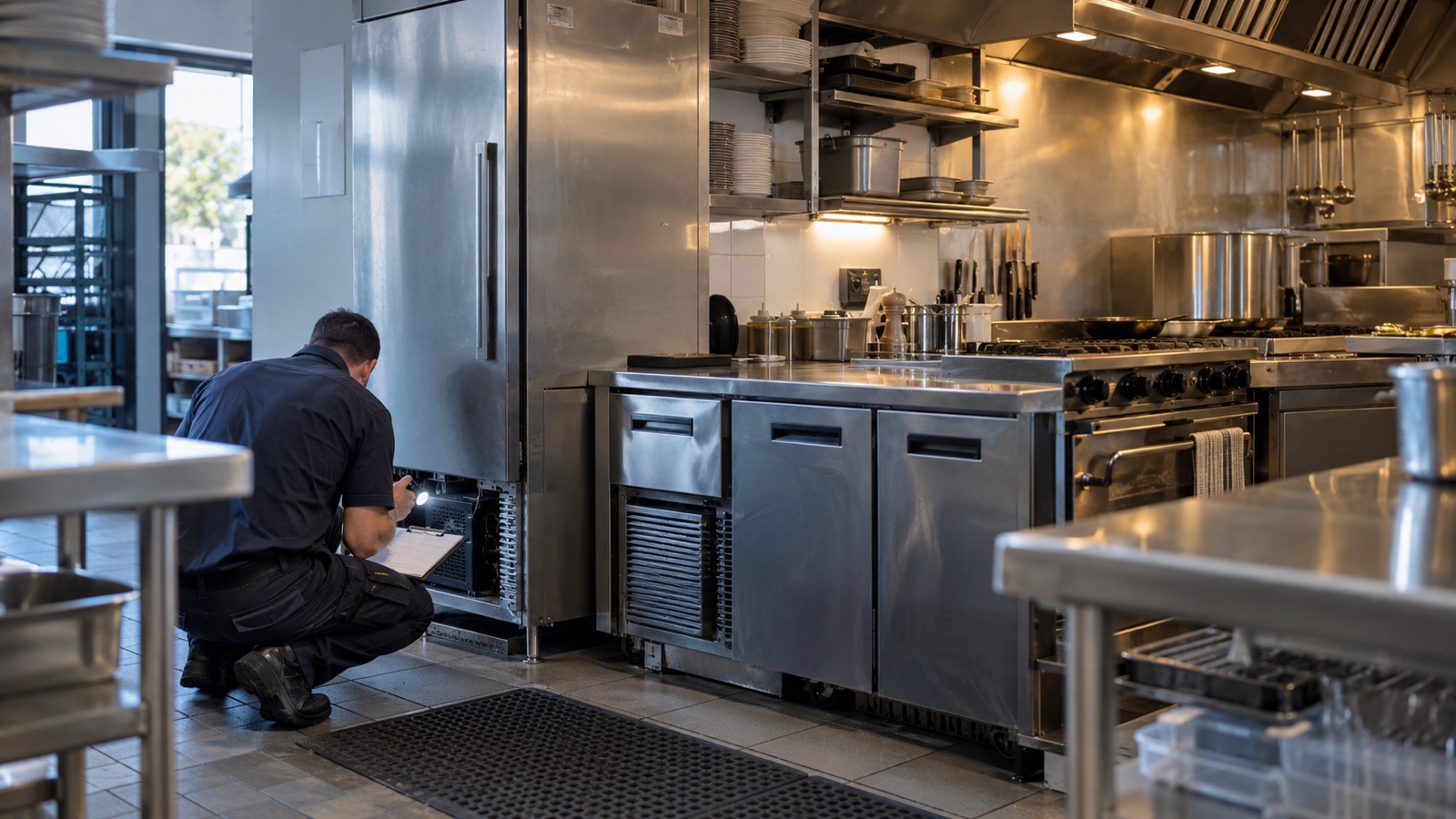
A café buyer should not value refrigeration, extraction and kitchen equipment from an asset list alone. Identify who owns each item, test its condition and capacity under normal trading demand, confirm how it is installed and approved, then estimate when repair or replacement cash is likely to be required.
The real exposure is broader than the price of a new appliance. It may include removal, access, electrical or gas upgrades, refrigeration pipework, drainage, duct changes, landlord and council approvals, installation downtime and temporary loss of sales. A working unit on inspection day can still create a material first-year capital requirement.
Build an equipment register that can be tested
Start with a room-by-room register rather than the seller’s depreciation schedule. Record every material refrigerator, freezer, cool room component, ice machine, extraction hood, fan and duct section, oven, cooktop, fryer, dishwasher, grease-management item and preparation appliance. For each item, capture:
- manufacturer, model, serial number and stated capacity;
- approximate installation date and whether it was bought new or used;
- legal owner, invoice, finance or hire arrangement and proposed transfer treatment;
- service provider, maintenance frequency, repair history and remaining warranty;
- power, gas, water, waste, ventilation and clearance requirements;
- observed condition, test result and known fault; and
- estimated repair, replacement, installation and downtime allowance.
Photograph nameplates and installation points. Reconcile the register to purchase invoices, fixed-asset records, finance agreements, service reports, lease documents and the sale contract. A fully depreciated item is not necessarily unusable, and a large accounting carrying value does not demonstrate physical condition.
Establish ownership before assessing value
Equipment on the premises may belong to the seller, landlord, coffee supplier, equipment financier or another lessor. Separate movable assets from fixtures and ask the transaction lawyer how the lease, sale agreement and applicable law treat each installation. Obtain written payout, consent, assignment or release requirements before assuming an item will pass at settlement.
The PPSR explains that machinery and equipment may be subject to security interests and that the register is not a register of ownership (PPSR). Appropriate searches therefore complement—not replace—invoices, contracts and releases. The search strategy and treatment of fixtures should be settled with a lawyer.
Test performance, condition and capacity
Arrange inspections by appropriately qualified refrigeration, electrical, gas and mechanical-exhaust specialists where material. Ask them to identify the failure mode and likely timing, not merely state that an item switched on.
For refrigeration, review compressor condition, refrigerant and leak history, door seals, insulation, evaporators, condenser cleanliness, drainage, controls, temperature recovery and alarm performance. Test in representative ambient conditions and after normal door openings or product loading. A cabinet that reaches temperature while empty before service may not recover during a summer lunch rush.
For extraction, inspect hood coverage, filters, grease accumulation, fan and motor condition, duct access, discharge point, make-up air, noise, vibration and cleaning records. For the cooking line, test thermostats, burners, elements, interlocks, guards, seals and controls. Review dishwashing temperature or chemical controls, water supply, drainage and cycle capacity. Note obsolete parts, unsupported models and repairs that have merely deferred replacement.
Service invoices are useful only when matched to serial numbers and faults. Repeated compressor replacements, call-outs for tripped circuits or temporary repairs may reveal a system problem rather than isolated maintenance.
Link refrigeration to food safety and operating cost
Food Standards Australia New Zealand says food businesses must store food so it remains safe and suitable, and its guidance includes keeping potentially hazardous food at 5°C or colder unless a safe alternative system can be demonstrated (FSANZ). Review temperature logs, calibration records, inspection reports, food-disposal incidents and corrective actions alongside an independent performance test.
Capacity matters as much as temperature. Check whether shelves allow separation, airflow and cleaning at peak stock levels. The national food-safety framework also sets requirements for the design and construction of premises, fixtures and equipment so the operation can minimise contamination and clean effectively (FSANZ). Damaged seals, inaccessible voids and corroded food-contact surfaces can therefore affect both maintenance economics and safe operation.
Obtain electricity bills and, where practicable, meter major loads. The current federal Refrigerated Cabinets Determination 2024 sets energy-efficiency, testing, marking and related requirements for covered commercial refrigerated cabinets. Registration or rating information can help compare eligible replacement models, but it does not measure the actual consumption or condition of an old installed unit.
Treat extraction and services as a system
A new menu or higher-volume forecast may exceed the existing kitchen’s extraction, electrical, gas, water or drainage capacity. Do not cost the appliance without testing the infrastructure that supports it.
The NCC page for kitchen local exhaust states that certain commercial cooking apparatus and combined loads trigger an exhaust hood designed to referenced standards (ABCB). Which NCC edition, state or territory variation, planning condition and approval applies to a particular existing premises must be confirmed with the relevant building professional, council and landlord. A replacement that changes fuel, output or layout can turn a simple purchase into a duct, switchboard or approval project.
Electrical records should include switchboard capacity, dedicated circuits, RCDs where required, equipment test records and past faults. Safe Work Australia’s model-WHS guidance says unsafe electrical equipment must not be used and identifies competent-person inspection and testing duties for certain equipment in higher-risk workplaces; it directs businesses to their state or territory regulator for local requirements (Safe Work Australia). Apply the same jurisdiction-specific discipline to gas work and certification.
Convert findings into a replacement schedule
For each item, estimate four numbers: remaining useful operating life, probability of failure, all-in replacement cost and revenue at risk during downtime. Then group expenditure into:
| Timing | Buyer treatment |
|---|---|
| Before settlement | Require repair, evidence, release or an agreed contractual outcome |
| First 12 months | Include in opening cash needs and downside funding |
| Years two to three | Build into the capital plan rather than normalised profit |
| Later or uncertain | Monitor with service triggers and a contingency |
Use current written quotes that include removal, access, trades, commissioning and taxes. Identify lead times and whether work can occur outside trading hours. Avoid double counting routine repairs in operating expenses and the same item again as full replacement, but do not remove genuine recurring maintenance from maintainable earnings.
Hypothetical example: an upright refrigerator is operating, but records show frequent call-outs, its seals are failing and the model has limited parts support. A quoted replacement is $12,000, while switchboard work, removal and two closed trading days add an estimated $7,000. The buyer’s exposure is therefore not the seller’s $3,000 book value or the appliance price alone; it is the supported all-in cash requirement and interruption risk. This example illustrates a method, not a benchmark.
Questions before relying on the equipment value
Before committing, ask:
- Does every material item have a clear owner, serial number and transfer path?
- Has performance been tested under representative load rather than only observed at idle?
- Do service histories reveal recurring faults, leaks, overheating or obsolete parts?
- Can refrigeration hold and recover safe temperatures at peak stock and ambient conditions?
- Will the buyer’s intended menu and volume fit existing extraction and service capacity?
- Are approvals, certificates and landlord obligations complete and transferable?
- Does the acquisition model fund all-in replacement costs and downtime at realistic dates?
Where evidence is missing, the response may be a specialist test, quotation, contract condition, price adjustment, capital reserve or a decision not to proceed. The appropriate treatment should be coordinated with the buyer’s lawyer, accountant, building consultant and licensed trades.
Related reading
- Café acquisitions
- Buying a Café in Australia: A Buyer’s Guide
- Café Due Diligence: Documents to Request Before Making a Commitment
- Food Costs, Waste and Menu Margins: What Café Buyers Should Investigate
- Coffee Equipment Ownership, Supplier Loans and Supply Agreements
Sources
- Protecting your business assets — Personal Property Securities Register, reviewed 2026-10-03
- Storing food safely — Food Standards Australia New Zealand, reviewed 2026-10-03
- Food Safety Standards (Chapter 3) — Food Standards Australia New Zealand, reviewed 2026-10-03
- Greenhouse and Energy Minimum Standards (Refrigerated Cabinets) Determination 2024 — Federal Register of Legislation, reviewed 2026-10-03
- Part F6 Light and ventilation — Australian Building Codes Board, reviewed 2026-10-03
- Electrical safety - WHS duties — Safe Work Australia, reviewed 2026-10-03
Disclaimer
This article provides general information only. It does not constitute legal, tax, accounting, financial, credit, valuation or other professional advice. Circumstances differ. Obtain advice from appropriately qualified advisers before acting or entering a transaction.

