
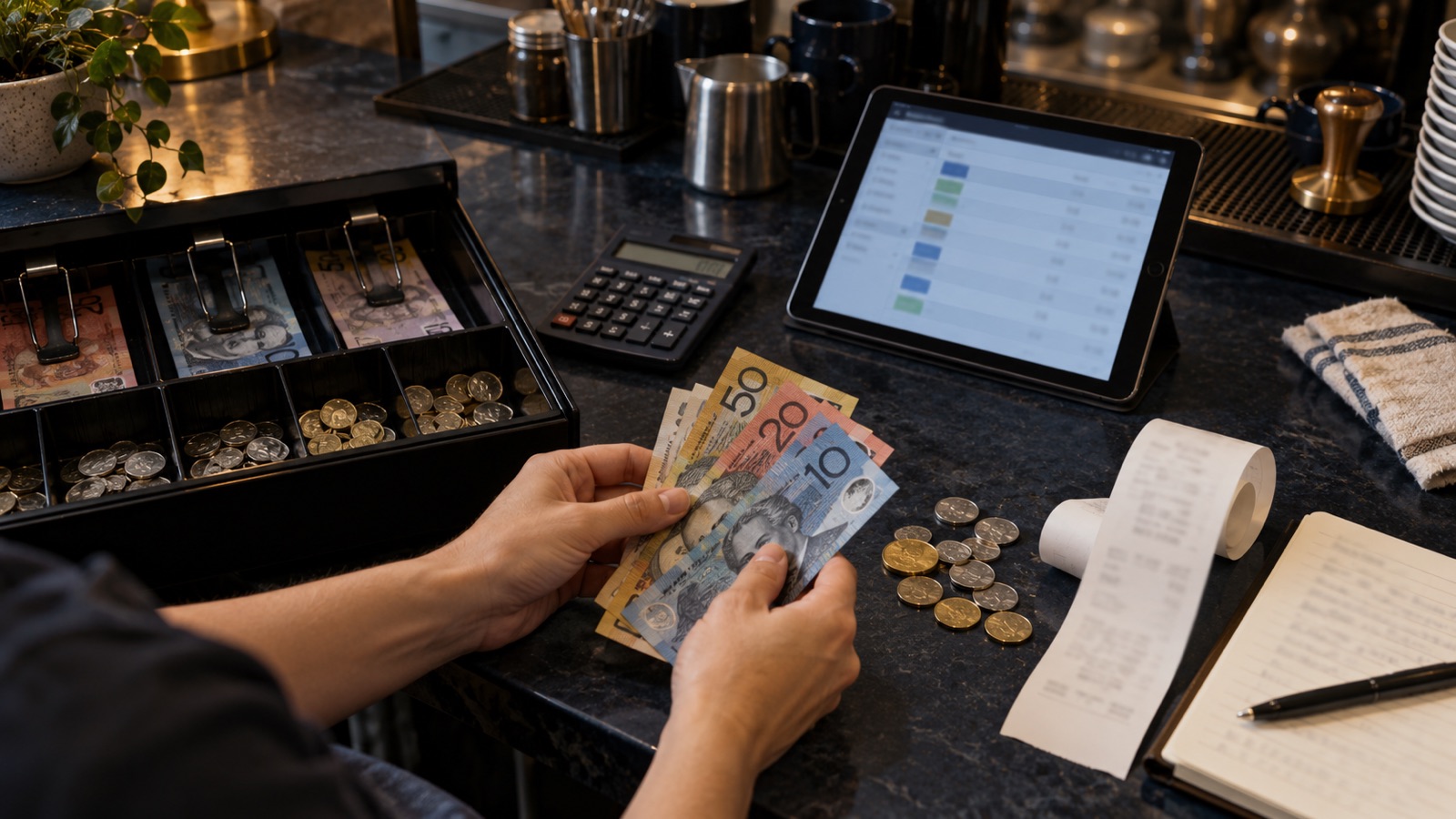
Cash sales in a café can be verified only to the extent that contemporaneous records form a coherent trail: the transaction is recorded at the point of sale, the till is counted, cash movements are documented, deposits and accounting entries reconcile, and lodged tax records are consistent. Cash itself is not the problem; the absence of an evidence trail is.
A seller’s estimate, a statement that “everyone pays cash”, or a claim that takings were deliberately left out of the books is not verified revenue. Buyers should not add unsupported cash to maintainable sales or earnings merely because the explanation sounds commercially plausible. Treat it as unverified unless advisers can trace it through reliable records.
Start with what “verified” should mean
Verification is stronger when records were created during ordinary trading, before the sale process began, and can be reproduced from systems or third parties. The Australian Taxation Office (ATO) says business records should explain transactions and include income records such as sales invoices, cash-register tapes, receipt books, and cash and digital sales records (ATO).
For a buyer, evidence falls into three practical levels:
- Traceable cash sales: transaction-level POS data, daily till counts, cash-up sheets and deposit records reconcile after documented movements.
- Corroborated but incomplete claims: some records agree, but gaps, timing differences or missing days prevent a complete reconstruction.
- Unsupported claims: estimates, handwritten summaries produced for the sale, unexplained cash, or alleged unrecorded takings with no contemporaneous trail.
Only the first level is close to independently testable. The second needs quantified limitations. The third may prompt questions, but it should not be converted into verified revenue by applying a percentage or averaging the seller’s recollection.
Build the daily cash bridge
Request native POS exports for a meaningful period, including transaction timestamps, payment tender, refunds, voids, discounts, deleted transactions and user activity. Add daily Z-totals or close-of-day reports, till-count sheets, opening and closing floats, petty-cash records, cash wages or drawings records where applicable, deposit slips, bank statements, the sales ledger, lodged business activity statements and annual accounts.
For each sampled day, reconstruct this bridge:
POS cash sales + opening float − refunds − documented cash expenses − cash drawings − closing float = cash expected to be banked
Then compare the expected amount with the deposit, allowing for clearly evidenced timing differences. The ATO’s banking guidance says businesses should bank cash sales regularly and undertake daily reconciliation so net cash sales banked balance after matters such as business expenses, wages, drawings and float are taken into account (ATO).
Taxation Ruling TR 96/7 also describes reconciliation of cash summaries and bankings and says the reconciliation must account for cash used for other purposes. Where no reconciliation is done, the ruling addresses retention of the individual records needed to explain transactions (ATO). This does not make every café’s records accurate, but it gives a buyer a disciplined evidence model.
Test whether the record trail is complete
Do not stop when daily sheets add up. Test whether all trading days and tills are present, whether receipt numbers run in sequence, and whether cash tender percentages change abruptly around holidays, staff changes or the sale campaign. Reproduce reports in a supervised, read-only system session where possible. Ask whether administrators can edit past transactions and obtain available audit logs.
Compare cash with electronic tender rather than assuming one proves the other. Payment-system operators report certain merchant acquiring, BPAY and direct-debit transaction information to the ATO, which uses it in tax administration, including income reporting compliance (ATO). That electronic data does not reveal cash takings, but it provides an independent comparison point. A sudden claim of unusually high cash sales should be tested against historical tender mix, transaction counts and customer behaviour.
The ATO also warns that electronic sales suppression tools can delete, resequence, reduce or misrepresent POS transactions and produce false records (ATO). One anomaly does not establish misconduct. However, missing audit logs, unexplained numbering gaps, altered databases or reports that cannot be regenerated justify specialist investigation rather than a convenient estimate.
Use operating evidence as corroboration, not proof
Coffee-bean, milk, cup and food purchases can help test whether claimed volumes are plausible. So can customer counts, average transaction values, rosters, opening hours, delivery-platform orders, stocktakes, waste records and observation of comparable trading days. These checks are particularly useful when the reported cash share is material.
But operational ratios do not prove revenue. Bean usage varies with drink size, dial-in waste, staff consumption and product mix. Food purchases may reflect spoilage or poor controls. Footfall does not prove payment or average spend. Use these measures to find inconsistencies and choose samples, not to manufacture a precise cash-sales figure where primary records are missing.
Likewise, a BAS or tax return is corroboration, not a transaction ledger or audit opinion. Ask the buyer’s accountant to bridge recorded sales to lodged amounts and explain GST treatment, reporting basis, journals and period cut-offs. If a seller says cash was excluded from tax records, the statement raises tax and integrity issues; it does not give the buyer a defensible earnings adjustment.
A hypothetical cash reconciliation
Hypothetical example: a café’s POS records $2,800 of cash sales for a week. Daily cash-ups total the same amount. Records show a $300 opening float, $120 of supported petty-cash purchases and a $100 owner drawing. The closing float is $300, so $2,580 should have been banked. Bank statements show a matching deposit two business days later.
That chain supports the recorded cash for the sampled week, subject to checking the completeness and integrity of the POS data. It does not prove that every sale entered the POS, or that the week represents a full year.
Now assume the seller claims a further $1,500 of weekly “cash not put through the system”. There are no receipts, till counts, deposits, purchase-volume records or lodged figures supporting it. That amount remains unverified. A buyer should not treat repetition of the claim as evidence.
Translate evidence gaps into the acquisition decision
Summarise cash findings by period and classify every difference as explained, partly supported or unresolved. Consider:
- how much reported revenue and profit depends on cash;
- whether records pre-date the sale and can be reproduced;
- whether cash percentages are stable across seasons and operators;
- whether all cash uses and deposit timing differences are documented;
- whether tax filings and financial accounts reconcile; and
- whether missing evidence affects price, finance, warranties or the decision to proceed.
Do not assume the buyer can preserve undocumented practices after settlement. The buyer’s operating controls, staffing and reporting obligations may be different, and a lender or valuer may give unsupported revenue little or no weight. Ask an accountant or forensic accountant to investigate material inconsistencies, a tax adviser to address tax records, and a lawyer to advise on representations, warranties, indemnities and transaction structure. Buyer-side commercial assessment cannot replace those specialist roles.
Related reading
- Café acquisitions
- Buying a Café in Australia: A Buyer’s Guide
- How to Verify Café Sales Using POS Records, Bank Deposits and Tax Records
- Café Due Diligence: Documents to Request Before Making a Commitment
Sources
- Overview of record-keeping rules for business — Australian Taxation Office, reviewed 2026-10-03
- Banking records – business — Australian Taxation Office, reviewed 2026-10-03
- TR 96/7 - Income tax: record keeping - section 262A - general principles — Australian Taxation Office, reviewed 2026-10-03
- Business transactions through payment systems report — Australian Taxation Office, reviewed 2026-10-03
- Electronic sales suppression tools (ESSTs) are on our radar — Australian Taxation Office, reviewed 2026-10-03
Disclaimer
This article provides general information only. It does not constitute legal, tax, accounting, financial, credit, valuation or other professional advice. Circumstances differ. Obtain advice from appropriately qualified advisers before acting or entering a transaction.

