
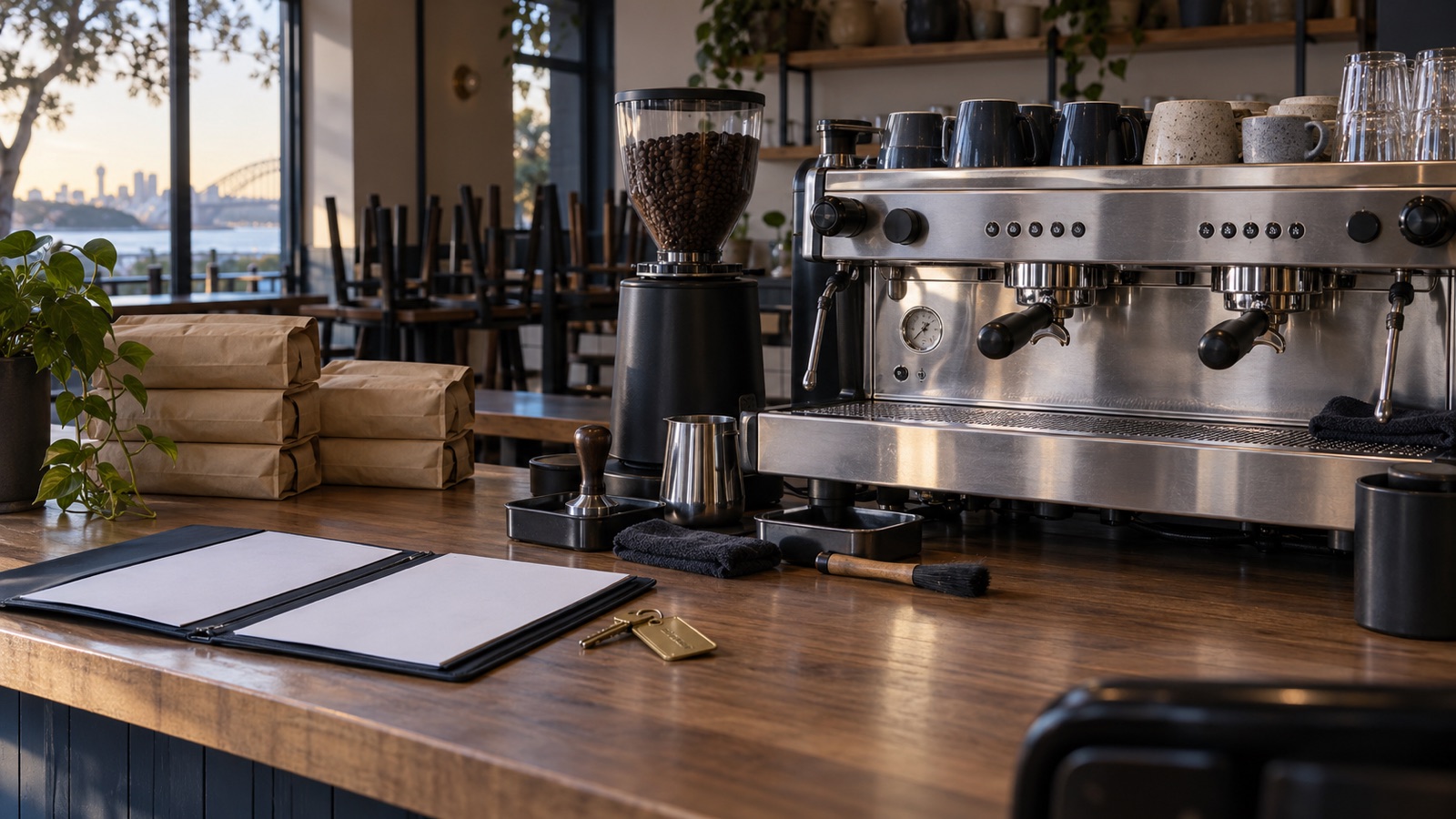
The espresso machine, grinders and filtration system in a café may not belong to the seller. They may be owned, financed, hired, leased or supplied for use under a coffee-purchase agreement. A supplier-loaned machine is not a cash loan: the supplier may retain title while the café can use the equipment only while buying an agreed product volume.
A buyer should therefore investigate the equipment and the supply contract as one operating arrangement. Confirm title, any security interest, the amount required to discharge finance, minimum purchases, exclusivity, rebates, servicing, transfer consent and exit costs. Do not include an asset in the purchase price, or assume it will remain after settlement, merely because it sits behind the counter.
Identify the arrangement before valuing the equipment
Start with an equipment schedule recording the manufacturer, model, serial number, location, condition and seller’s claimed basis of possession. Assign each item to one category:
- owned outright: the seller has paid for it and can demonstrate title;
- financed or under hire purchase: the café uses the equipment but a financier may have rights until payment and discharge;
- leased or rented: a third party owns the item and charges for its use;
- supplier-loaned: a roaster or other supplier retains the equipment while use depends on buying coffee or meeting other conditions; or
- unclear: records conflict, invoices are missing or different entities appear across the documents.
An invoice alone may show a deposit, financed purchase, related entity as buyer or equipment “on loan”. Match invoices and bank payments to the asset register, depreciation schedule, finance ledger, insurance and supplier correspondence. Use ASIC’s register search to check legal names and identifiers; a trading name does not establish which entity contracted or owns an asset.
Search for security interests, but understand the limit
The Personal Property Securities Register can reveal registered security interests over personal property. The PPSR explains that it is not a register of ownership and that hired or leased equipment, retention-of-title goods and financed assets can be relevant to registrations (PPSR). A clear search is therefore useful evidence, not proof that the seller owns every machine.
Search against the correct grantor identifier and retain the certificate. The PPSR uses a coffee maker as an example of valuable second-hand equipment and says an organisation search can reveal registered interests, but not their value (PPSR). Coffee machines are generally not searched as serial-numbered goods, so the correct grantor search matters. Ask a lawyer or PPSA specialist to select the searches and interpret any registration.
Where finance or a registration exists, obtain the underlying agreement, current payout figure and release process. The sale contract should address whether an item is excluded, transferred with consent or delivered free of the relevant interest. A promise that the seller will “sort it out later” is not a discharge mechanism.
Read the coffee supply agreement as an operating cost
Supplier support may make equipment appear inexpensive while moving its economics into coffee purchases. Obtain the signed agreement, every schedule and variation, not just recent invoices. Australian Government supplier guidance recommends written terms covering matters including goods or services, price and payment, timeframes, quality, warranties, insurance, disputes and termination (business.gov.au). For a café, map at least:
| Term | Evidence to obtain | Buyer question |
|---|---|---|
| Equipment and title | Equipment schedule, delivery record and ownership clause | Exactly which machines, grinders, filters and accessories remain supplier-owned? |
| Minimum purchase | Kilograms or dollar threshold, measurement period and product list | Is the commitment realistic under verified sales and the buyer’s intended menu? |
| Exclusivity | Covered products, site and permitted alternatives | Can the café buy decaf, specialty beans or another brand without breach? |
| Price and rebates | Current price list, adjustment clause, credits and rebate statements | Is the rebate earned only after a threshold, and is it included correctly in reported margins? |
| Shortfall and exit | Make-up purchases, damages, equipment return and early-termination formula | What is payable if volumes fall, the concept changes or the café closes temporarily? |
| Transfer | Assignment, novation, change-of-control and consent clauses | Does the agreement transfer, require approval or terminate on sale? |
| Service | Preventive maintenance, call-out response, parts, loan units and exclusions | Who pays for downtime, consumables and repairs caused by water quality or misuse? |
Recalculate historical coffee cost using invoices, credit notes and kilograms purchased. Keep bean cost, equipment benefit, rebates and service charges visible rather than netting them into one margin. An annual rebate may improve past reported profit but fail to continue if the buyer’s volume, product range or contracting entity changes.
Test volume commitments against the buyer’s plan
Compare contractual purchases with POS beverage sales, recipe usage, wastage and stock movements by week. Check whether the agreement measures all coffee products together or only nominated blends, and whether the threshold applies weekly, monthly or annually. Also test seasonality, closure periods and planned trading-hour changes.
Hypothetical example: a supplier-owned espresso machine is provided while the café purchases at least 18 kilograms of nominated beans each week. Verified purchases average 19 kilograms, but a buyer plans to close one trading day and replace some coffee sales with another product. The historic threshold being met does not prove the future plan will comply. The buyer would model expected kilograms, any shortfall charge, the value of forgone alternatives and the cost of buying or leasing replacement equipment. These figures illustrate the method only; they are not an industry benchmark.
Look beyond the headline rate for automatic renewal, unilateral price changes, guarantees, direct debits, indemnities, premises-access rights, compulsory consumables and repayment of installation or training support. The ACCC’s current contracts guidance explains that protections can apply to standard-form small-business contracts and identifies current thresholds; only a court can finally determine whether a term is unfair. Do not assume an onerous clause is invalid.
Make transfer a settlement workstream
Supplier consent can affect whether the café can trade on day one. Before the sale becomes unconditional, seek written confirmation of:
- which equipment the supplier owns and will leave on site;
- whether the existing agreement will be assigned, novated or replaced;
- the buyer entity, credit checks, deposit or guarantee the supplier requires;
- opening prices, minimum volumes, rebates and service levels under the buyer’s agreement;
- any arrears, shortfall, breach or dispute attached to the seller;
- any payout, release, collection or installation required at completion; and
- responsibility if consent or replacement equipment is delayed.
Supplier acceptance is different from the seller’s assurance that the relationship will continue. If the buyer must sign a new contract, model that contract. Coordinate completion with the equipment schedule, landlord access, insurance, utilities and an independent inspection.
Frequently asked questions
Does a machine on the café’s asset register belong to the seller?
Not necessarily. The register is accounting evidence, not conclusive title. Compare it with invoices, payment evidence, finance and supplier agreements, PPSR searches and written confirmations from any claimed owner or secured party.
Is “free on loan” equipment actually free?
Usually the economics sit elsewhere. The café may accept minimum purchases, exclusivity, pricing rules, return obligations or shortfall and termination costs. Quantify the total arrangement and compare it with independently owned or leased equipment.
Can the buyer take over the supplier agreement automatically?
Do not assume so. The contract may prohibit assignment, require consent, treat a sale or change of control as a trigger, or require a new agreement. A lawyer should review the mechanism and align it with settlement.
When specialist advice is needed
Ask a transaction lawyer to review title, security interests, guarantees, assignment, termination and completion protections. Use an accountant to test rebate and cost treatment, and a qualified technician to assess condition, service history, capacity and replacement needs. A machine can work but not be owned, be owned but encumbered, or be available only under an uneconomic commitment.
Related reading
- Café acquisitions
- Buying a Café in Australia: A Buyer’s Guide
- Café Due Diligence: Documents to Request Before Making a Commitment
- Refrigeration, Extraction and Kitchen Equipment: Assessing Replacement Exposure
Sources
- Protecting your business assets — Personal Property Securities Register, reviewed 2026-10-03
- Do an organisation search — Personal Property Securities Register, reviewed 2026-10-03
- Contracts — Australian Competition and Consumer Commission, reviewed 2026-10-03
- Search ASIC registers — Australian Securities and Investments Commission, reviewed 2026-10-03
- Suppliers — Australian Government business.gov.au, reviewed 2026-10-03
Disclaimer
This article provides general information only. It does not constitute legal, tax, accounting, financial, credit, valuation or other professional advice. Circumstances differ. Obtain advice from appropriately qualified advisers before acting or entering a transaction.

