
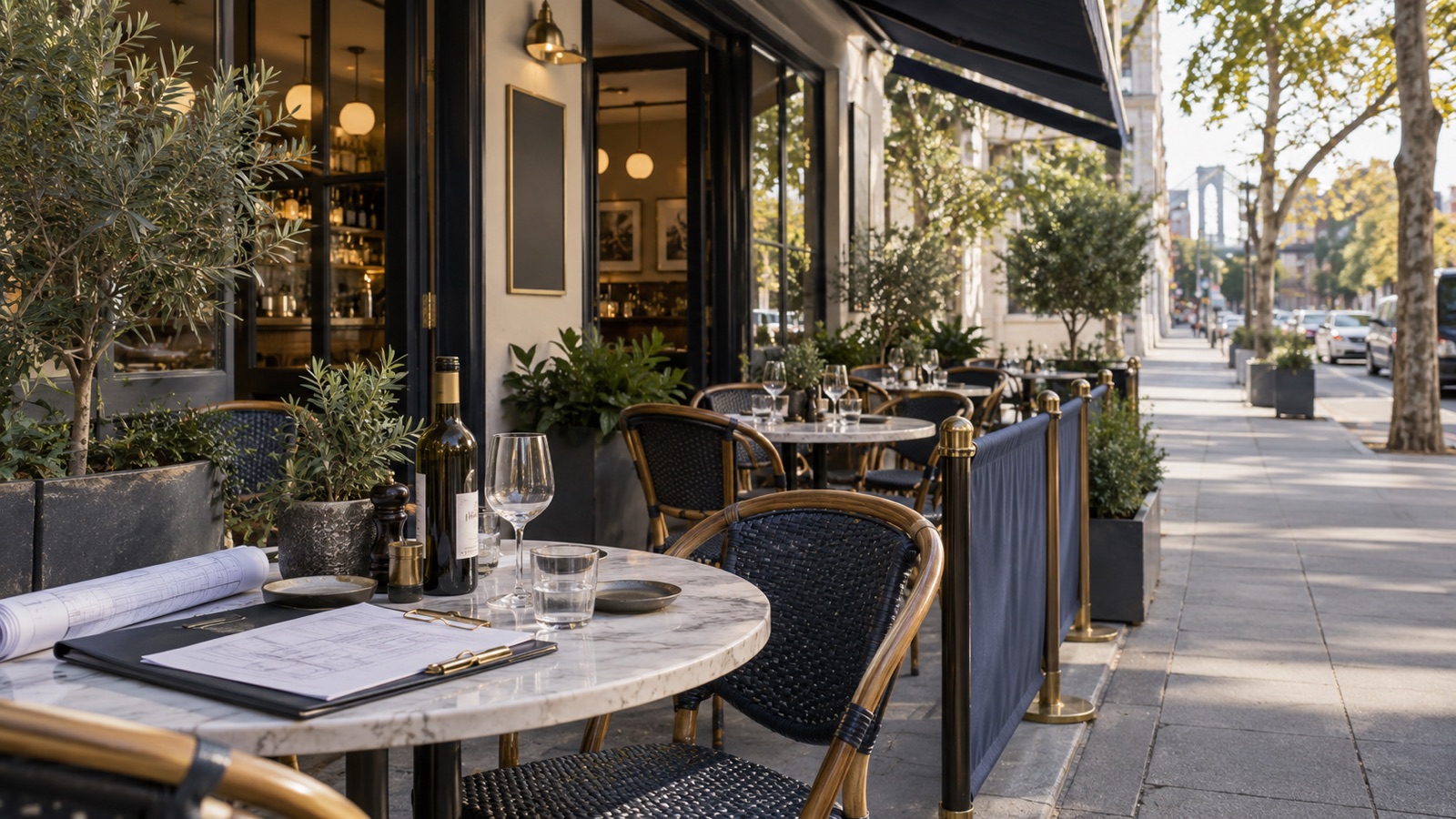
A café sale does not, by itself, guarantee that the buyer can keep using the footpath, serve alcohol or trade the same hours. Treat the premises approval, outdoor dining approval and liquor licence as separate permission streams. Verify the holder, site, approved footprint, hours, capacity, conditions, expiry and process for transfer or a fresh application.
The commercial question is whether those permissions will support the buyer’s operating plan from settlement. If outdoor seats or licensed evening trade contribute materially to earnings, suitable approvals should be an acquisition condition—not an assumption left for after completion. Australian requirements vary by state, territory and council, so the examples below are illustrations, not a national rule.
Build three approval schedules
Ask the seller for a complete current copy of every approval, not a photograph of a certificate on the wall. Organise the material into three schedules.
Premises and planning: development consent or planning permit, stamped plans, occupation or building records, approved use, hours, patron capacity, noise conditions, waste and delivery restrictions, any plan of management, and correspondence about complaints or breaches.
Outdoor dining: council or land-manager permit, approved plan and dimensions, permitted hours, furniture and barrier conditions, pedestrian-clearance requirements, insurance obligations, fees, expiry or renewal terms, and evidence identifying the approved operator. Separate tables on private land from those occupying a footpath, road, mall or other public land.
Liquor: the complete licence or permit, licensed-area or red-line plan, licence type, licensee, approved hours, service conditions, RSA and manager requirements, annual fees, disciplinary history and pending applications. Check whether every outdoor table at which alcohol is served lies within both the outdoor dining area and the licensed boundary.
Create one comparison table showing what the café does now, what the documents permit, what the buyer intends to do, and what approval action is required. Inconsistencies are more useful than a general assurance that the business has “always traded this way”.
Test whether the outdoor dining right continues
First establish who controls the land. A lease may include a private courtyard but not the public footpath outside it. A council permit may be issued to the current operator, limited to a particular layout or renewable periodically. The buyer should obtain the relevant authority’s written position on whether the permit can be updated, transferred or must be applied for again.
NSW illustrates why the layers matter. The NSW Planning Portal says qualifying footpath dining may be exempt from planning consent, but the café must already be approved as a food or drink premises and the outdoor area must still comply with relevant Roads Act and Local Government Act approvals (NSW Government Planning). “Exempt development” therefore does not mean no council or land-use permission is required.
Council requirements are also location-specific. The City of Sydney requires outdoor dining approval and asks applicants for proposed hours, the approximate area and a site plan showing dimensions, obstructions and a clear pedestrian path. Its process allows an existing approval to be updated for a change of operator, hours, layout or area; an application involving road space has additional assessment. It also says liquor-licence boundaries must match the approved outdoor area where alcohol is served (City of Sydney). A buyer elsewhere should ask that site’s council or land manager the equivalent questions rather than applying Sydney’s rules.
Inspect the physical layout against the approved plan. Measure the footprint, count seats, locate umbrellas, heaters and barriers, and confirm an accessible clear path remains. Check whether furniture must be removed outside approved hours and whether events, construction or public works can temporarily displace the area. Revenue attributed to outdoor seats should reflect weather and the legal seating capacity, not the maximum number the seller sometimes places outside.
Do not assume the liquor permission follows the sale
Confirm the correct incoming entity and apply early. Transfer mechanics differ between jurisdictions. In NSW, a liquor licence can be transferred when a licensed business is sold; the authority describes provisional approval followed by later confirmation, and the incoming applicant must provide specified supporting material (NSW Government). In Victoria, the incoming person or entity normally applies, should apply at least eight weeks before the intended change, and must not supply alcohol until the transfer is granted and it has the legal right to occupy the venue (Victorian Government).
These different processes affect settlement drafting and timing. The buyer’s lawyer should identify whether the transaction needs approval, provisional approval or another regulatory milestone before completion; who must cooperate and sign; what happens if approval is delayed or refused; and whether the buyer can lawfully trade without alcohol in the interim.
Read the licence conditions and plan, not only the licence category. Verify that the permitted business model covers meals, bar-style service, takeaway or delivery as applicable. Check the licensed boundary, service hours, capacity, required manager arrangements and special conditions. A transfer to the buyer does not necessarily expand an old licence to cover the buyer’s proposed hours, new terrace or revised concept.
Reconcile every restriction to one operating model
The lawful trading envelope may be set by several documents. Planning consent might permit the indoor café until 10 pm but limit the terrace to 8 pm. The outdoor permit might authorise fewer tables. The liquor licence may authorise alcohol only in a marked area or during narrower hours. The lease may impose still tighter opening, noise, delivery or common-area rules.
Use the most restrictive applicable limit in the acquisition model until an adviser or authority confirms otherwise. NSW liquor guidance, for example, says changes to liquor trading hours may also require a variation to the premises’ development consent, and changing licence hours does not automatically change the hours of separate authorisations (NSW Government).
Review complaints, warnings, penalty notices, noise reports and regulator correspondence. Ask the seller and landlord about neighbour disputes, informal operating concessions and uncompleted remedial work. Check whether restrictions cover patron noise, amplified music, waste collection, bottle disposal, deliveries, smoking, lighting, heaters or furniture storage. An absence of recent enforcement is not evidence that an unapproved practice is permitted.
Convert permission risk into transaction protections
Where a permission is commercially important, discuss a condition precedent or other contractual protection with the transaction lawyer. The condition should identify the required authority outcome, incoming entity, footprint, hours, capacity and acceptable conditions. “Liquor licence transfer” alone may be too vague if the approval excludes the courtyard on which the forecast depends.
Build a settlement responsibility list covering seller consents and signatures, application fees, landlord documents, authority inspections, insurance, manager appointments, staff training, display notices and handover of online regulatory accounts. Do not let the seller cancel, surrender or vary a material approval before the agreed pathway is complete.
Hypothetical example: a café’s information memorandum attributes strong summer evening sales to 28 outdoor seats and wine service until 10 pm. The council plan supports only 20 outdoor seats until 8 pm, while the liquor plan covers the indoor area only. The buyer should model the documented position, value any upside from new approvals separately, and make the deal response depend on legal and regulatory advice. This is an assessment example, not a statement about any actual café.
Before relying on the forecast, the buyer should be able to answer:
- Which entity will hold each permission immediately after settlement?
- Do approved plans match the café’s current indoor, outdoor and licensed footprints?
- Which document sets the tightest hours and capacity for each area?
- Are transfer, update, renewal or new-application steps required—and by when?
- What revenue and cost assumptions fail if an approval is delayed or narrower than expected?
- What contractual outcome applies if a critical permission is refused?
Engage the transaction lawyer on licences, consent conditions, lease alignment and contract protections. Planning, liquor-licensing, acoustic, access or building specialists may be required for site-specific issues. The accountant should recast maintainable earnings using the verified trading envelope, while the buyer retains responsibility for deciding whether the remaining restrictions fit the intended operation.
Related reading
- Café acquisitions
- Buying a Café in Australia: A Buyer’s Guide
- Food-Business Approvals and Inspection Records: Questions Before Buying a Café
- Renovation, Rebranding and Closure Risk After Buying a Café
Sources
- Transfer a liquor licence — NSW Government, reviewed 2026-10-03
- Transfer your liquor licence — Victorian Government, reviewed 2026-10-03
- Manage, modify or move your liquor licence — NSW Government, reviewed 2026-10-03
- Footpath Dining and Mobile Food Vending — NSW Government Planning, reviewed 2026-10-03
- Apply for outdoor dining approval — City of Sydney, reviewed 2026-10-03
Disclaimer
This article provides general information only. It does not constitute legal, tax, accounting, financial, credit, valuation or other professional advice. Circumstances differ. Obtain advice from appropriately qualified advisers before acting or entering a transaction.

