
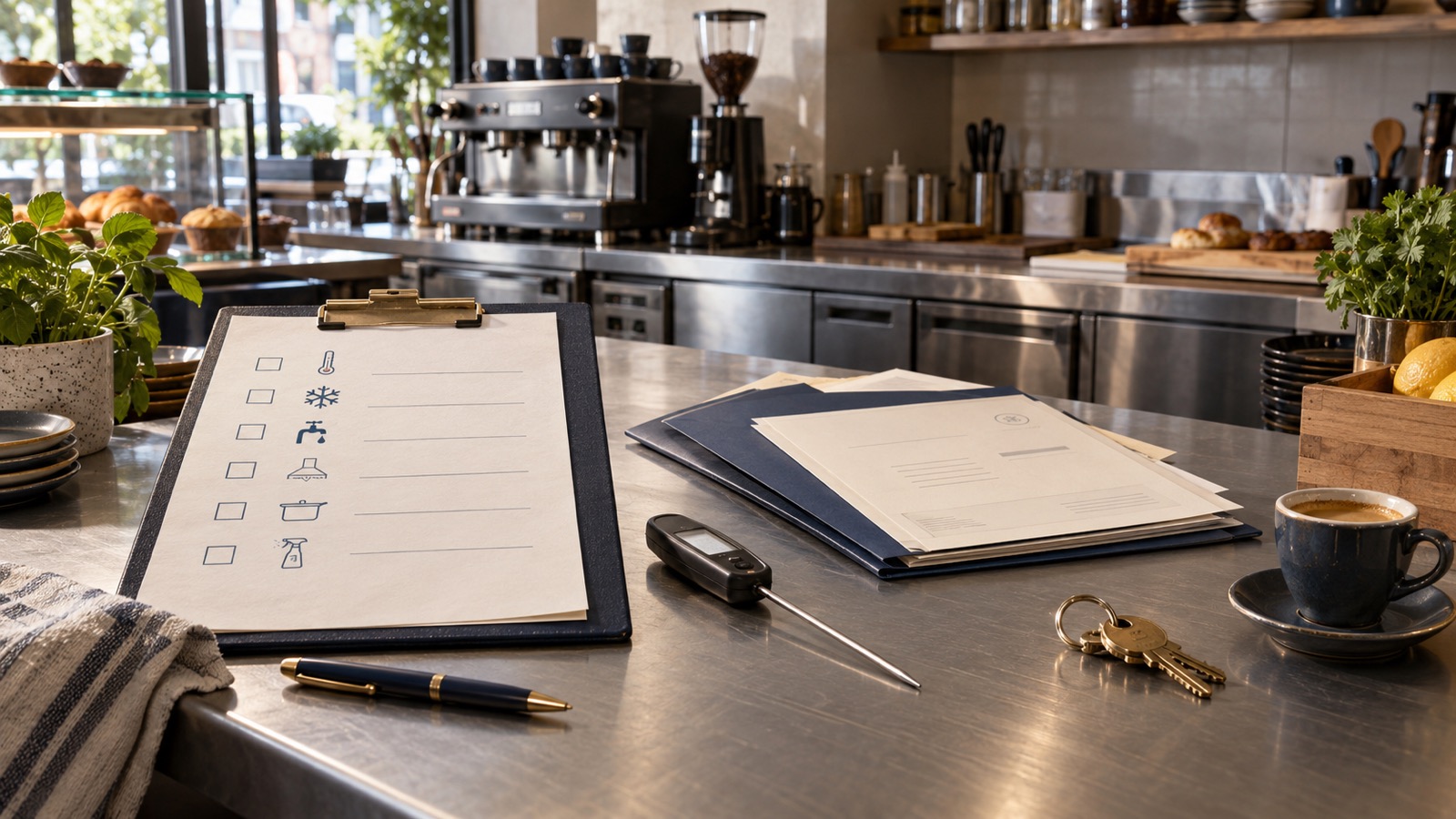
Before buying a café, verify that the premises and current operator have the food-business registrations, notifications or licences their jurisdiction requires—and establish what the buyer must obtain in its own name. Do not treat an existing certificate on the wall as proof that the buyer may trade from settlement.
Also obtain the complete inspection and enforcement file, not merely the latest satisfactory result. The practical question is whether the café’s present activities are authorised, whether past findings were closed out, and whether a new operator can lawfully continue the same menu and operating model without delay or remedial expenditure.
Start with jurisdiction, operator and actual activities
Australia has national food standards, but administration and enforcement differ between states, territories and councils. Food Standards Australia New Zealand (FSANZ) says a new food business, or one changing its name, location or activities, must tell its local food regulatory agency under Standard 3.2.2 (FSANZ). Notification is not the same thing as every state or council approval a café may need.
Ask the seller to identify:
- the legal proprietor recorded by each regulator;
- the premises address, approved food activities and risk classification;
- every council, state or territory registration, notification or licence number;
- the registered trading name and any earlier names;
- the approved menu and processes, including raw egg, sous-vide, catering or off-site preparation where relevant; and
- any planning, building, occupancy, wastewater or other permission that affects food operations.
Compare those details with the sale entity, asset list and the café’s real operations. A registration in the seller company’s name, or for a narrower activity, may not cover the buyer or its intended concept.
Documents and records to request
Build a register showing the document, issuing authority, legal holder, expiry date, conditions, transfer position and action required. Request originals or regulator-issued copies of:
- current and historical registration, notification and licence documents;
- applications, renewals, fee receipts, classifications and attached conditions;
- all routine and follow-up inspection reports for an agreed period;
- warning letters, improvement notices, prohibition orders, penalty notices and closure correspondence;
- evidence that each finding was rectified and accepted as closed;
- complaint logs, food-safety incidents, recalls and regulator correspondence;
- food safety supervisor certificates and appointment details;
- food-handler training records and competency evidence;
- any required food safety program, audits and corrective-action reports; and
- temperature, receiving, storage, cleaning, sanitising and pest-control records.
Ask for records across enough time to identify repeated findings, not just the most recent visit. In NSW, for example, the Food Authority tells businesses to examine their last hygiene and food-safety inspection report and says a copy can be requested from the local council if it cannot be found (NSW Food Authority). Access arrangements and what a regulator can disclose to a prospective buyer vary, so the seller may need to make the request or provide written authority.
Test food-safety management obligations
FSANZ explains that Standard 3.2.2A applies to food-service, catering and related retail businesses handling unpackaged, potentially hazardous, ready-to-eat food. Depending on whether a business is category one or category two, the tools include a certified food safety supervisor, trained food handlers and evidence that critical controls are being managed (FSANZ). A typical café may fall within the standard, but its exact category depends on what it handles and does.
For a food safety supervisor, check the named person, certificate, recognised course, issue date and whether that person will remain after the sale. FSANZ states that formal FSS certification must have been obtained within the past five years. If the supervisor is the seller or a departing employee, make recruitment or training part of the transition plan rather than assuming the certificate belongs to the premises.
For category one operations, test the “evidence tool” in practice. FSANZ says records generally must be kept for at least three months, although a business may instead demonstrate adequate controls to an authorised officer in another way (FSANZ). Sample busy and quiet days. Check whether records identify the date, food or activity, temperature or control, person responsible and response to an exception. A pristine template with repeated identical entries is not a substitute for credible operating evidence.
A “food safety program” is a separate concept and is not automatically required for every café in every jurisdiction. Ask the regulator or a qualified food-safety adviser which program, audit and record obligations apply to this premises and menu.
Read inspection history as a pattern
Classify each inspection finding by subject—temperature control, cleaning and sanitising, handwashing, pests, premises condition, allergen handling, training or records—and record the due date and proof of closure. Then ask:
- Was the problem isolated or repeated across inspections?
- Was it corrected with evidence, or did it disappear only because a later report was not supplied?
- Does the remedy depend on staff behaviour, new procedures or capital works?
- Could the same issue recur when the seller or key supervisor leaves?
- Is there an outstanding notice, review, appeal, complaint or reinspection fee?
Public registers can supplement this work but are not a complete compliance history. Names, entities and publication periods may differ, while complaints may be unsubstantiated or confidential. Search the café name, address, seller entity and former trading names where a jurisdiction provides a register, then reconcile any result with regulator and seller records.
Hypothetical example: a seller provides a current registration and a recent satisfactory inspection. Earlier reports show two temperature-control findings, while the food safety supervisor is the seller and the buyer plans to add off-site catering. The current certificate does not answer whether the old issue was sustainably corrected, who will supervise after settlement, or whether the expanded activity needs a changed notification or approval. This is an investigation example, not a conclusion about any café.
Confirm the change-of-operator process directly
Do not assume “transfer” has the same meaning everywhere. In NSW, retail cafés notify their local council; the NSW Food Authority states notification records are private to each business and a buyer must notify again with its own details (NSW Food Authority). In Brisbane, the council says a buyer taking over an existing business must apply for a new food licence because licences are not transferable (Brisbane City Council). These are jurisdiction-specific examples, not Australia-wide rules.
Contact the relevant council or regulator using the buyer’s intended entity, menu, hours and processes. Ask what application is required, whether an inspection or plans are needed, typical dependencies, fees, and the earliest lawful trading date. Obtain the answer in writing where possible.
Turn unresolved matters into completion conditions
The buyer’s lawyer should decide how regulatory risks are reflected in the sale documents. Depending on the facts, possible conditions include:
- receipt and satisfactory review of the complete inspection and notice file;
- written confirmation that no disclosed enforcement matter remains outstanding;
- the buyer obtaining its required registration, notification or licence;
- regulator acceptance of a change of proprietor or activity;
- completion and evidence of agreed repairs, cleaning or pest treatment;
- delivery of food-safety records and procedures at settlement; and
- a workable handover to an appropriately qualified food safety supervisor.
Do not let a proposed completion date force the buyer to trade without the required authority. Legal advice is needed on warranties, indemnities and conditions; a food-safety or building specialist may be needed to test technical rectification; and the regulator remains the source for requirements in its jurisdiction.
Related reading
- Café acquisitions
- Buying a Café in Australia: A Buyer’s Guide
- Café Due Diligence: Documents to Request Before Making a Commitment
- Outdoor Dining, Liquor Permissions and Trading Restrictions in a Café Acquisition
Sources
- Starting or changing a food business — Food Standards Australia New Zealand, reviewed 2026-10-03
- Standard 3.2.2A - Food safety management tools — Food Standards Australia New Zealand, reviewed 2026-10-03
- Evidence tool — Food Standards Australia New Zealand, reviewed 2026-10-03
- Licensing and notifying — NSW Food Authority, reviewed 2026-10-03
- How to get a better inspection result — NSW Food Authority, reviewed 2026-10-03
- Apply for a food licence — Brisbane City Council, reviewed 2026-10-03
Disclaimer
This article provides general information only. It does not constitute legal, tax, accounting, financial, credit, valuation or other professional advice. Circumstances differ. Obtain advice from appropriately qualified advisers before acting or entering a transaction.

