
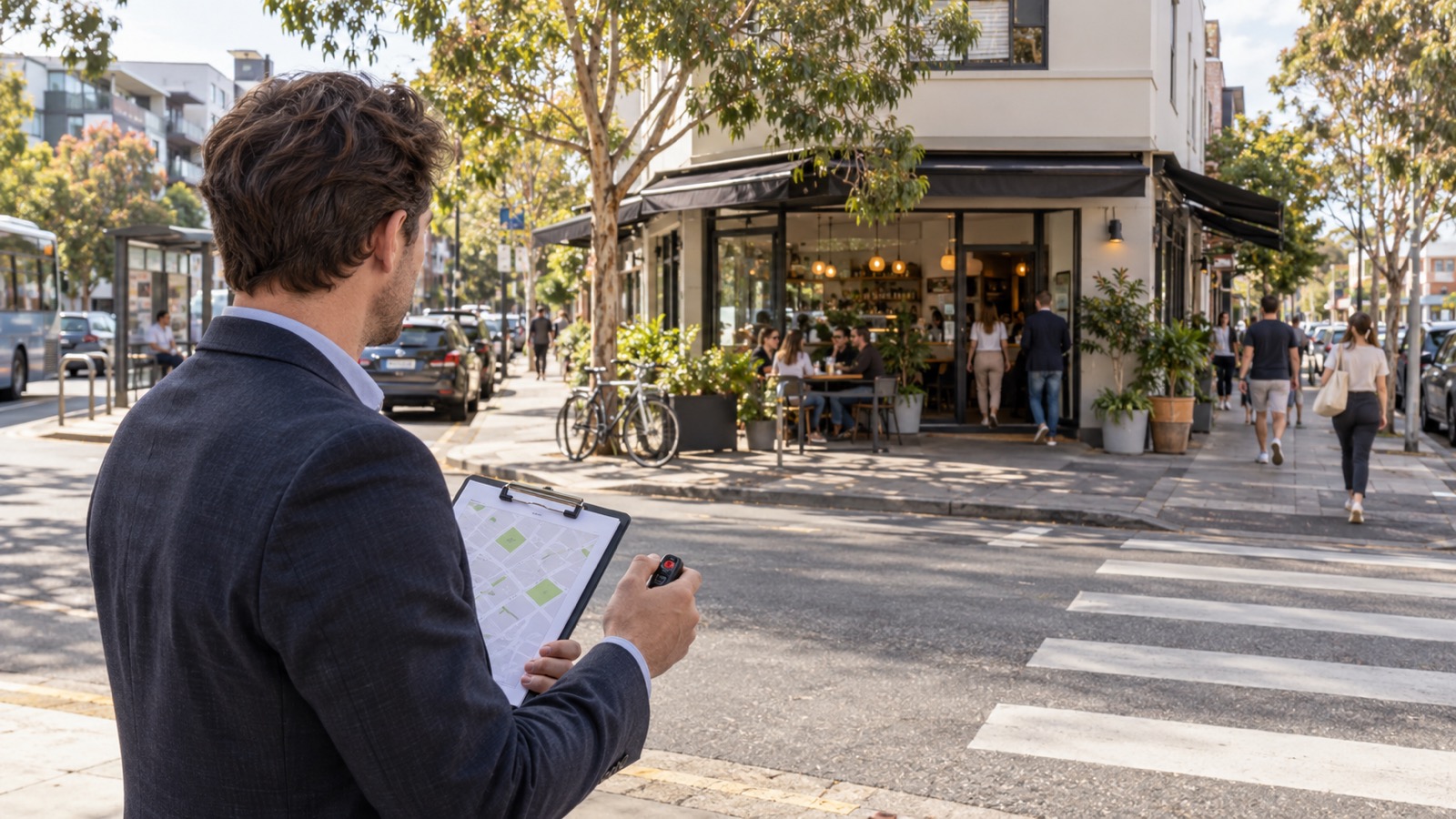
A café location should be assessed as a chain of evidence, not described simply as “high foot traffic”. A buyer needs to observe who passes, when they pass, whether they can see and enter the café, how many visits become transactions, and whether the pattern supports the café’s actual revenue mix.
The investigation should also test access, demand generators, nearby alternatives, proposed developments and the lease conditions that preserve—or weaken—the location advantage. A busy inspection at 10 am on one Saturday is not proof of sustainable demand.
Define what the location must do
Start with the café’s operating model. A commuter coffee bar may depend on weekday station flows and rapid pickup. A neighbourhood brunch café may rely on weekend dwell time, parking and pram access. A venue with catering or delivery revenue may be less exposed to passing pedestrians but more sensitive to loading, rider access and kitchen dispatch.
Map each material sales stream to a location requirement. For example:
- takeaway coffee: visibility, morning flow, convenient stopping and service speed;
- dine-in: nearby residents or workers, seating appeal and time spent in the area;
- delivery: rider access, dispatch space and a viable delivery catchment;
- catering: vehicle loading, commercial customers and reliable access; and
- weekend trade: local households, recreation, events and parking availability.
The Australian Government’s location guidance asks businesses to consider proximity to customers, foot traffic, public transport, parking, supplier access, zoning, permits and future development (business.gov.au). Those are separate variables. Strong performance on one does not cancel a serious weakness in another.
Observe foot traffic by daypart
Create an observation plan before visiting. Cover the café’s important opening periods across several ordinary weekdays and weekends. Include opening, commuter peaks, mid-morning, lunch, afternoon and closing where relevant. Repeat observations in different weather and during school holidays or local events only if those conditions materially affect trade, and label them so they are not mistaken for normal periods.
Use the same observation point and time interval on each visit. Record:
| Field | What to capture |
|---|---|
| Passing flow | Direction, approximate count and relevant customer type |
| Café interaction | Entrants, queue, occupied tables, takeaway pickups and departures |
| Friction | Missed crossings, blocked sightlines, full parking, steps or difficult turns |
| Nearby activity | Office changeovers, school movements, trains, buses, deliveries and events |
| Conditions | Date, time, weather, roadworks and any unusual promotion or closure |
Do not count every passer-by as a potential customer. Separate people walking on the café side from those across a barrier road; commuters rushing toward a platform from residents strolling; and people entering the café from those merely waiting nearby. Observe lawfully from public areas and avoid collecting identifiable personal information.
Reconcile observations to transactions
Footfall becomes useful when tested against trading records. Compare observation intervals with timestamped POS transactions, order channel, item mix, table occupancy and staff rosters. Ask the seller to explain periods when the street looks active but café transactions are weak, or when sales remain strong despite modest visible traffic.
Hypothetical example: during one weekday morning interval, a buyer counts 120 relevant passers, 18 café entries and 14 POS transactions. During a Saturday interval, 180 people pass but there are only 12 entries and nine transactions. These figures are not industry benchmarks. They simply show why raw traffic and conversion must be distinguished, then retested over enough periods to understand the pattern.
Compare observed activity with the customer-count and average-spend analysis. If the seller says weekday workers drive revenue, check whether transaction timing follows office arrival and lunch periods. If delivery or catering explains the gap, verify those channels separately. Do not extrapolate annual sales from a handful of counts.
Test access from the customer’s perspective
Walk the final approach from each demand generator: station, bus stop, office building, school, shopping area, car park and residential street. Note crossing locations, gradients, shade, lighting, narrow paths, construction hoardings and whether the storefront is visible early enough to influence a choice.
Check practical access for wheelchairs, mobility aids and prams with an appropriately qualified adviser where compliance is in question. Inspect parking restrictions at the times customers actually visit—not only when spaces happen to be empty. Verify loading arrangements, waste collection, delivery-rider waiting and whether vehicles can enter and leave safely.
For public transport, record service frequency and operating hours from the relevant transport authority, then observe whether passengers naturally pass the café. A nearby stop on a map may direct people away from the frontage. Conversely, a modest pedestrian count with easy short-stay parking can suit a destination café. The question is whether access fits the business model, not whether one mode looks impressive.
Define the catchment and its demand generators
Draw practical walking, driving and delivery catchments rather than choosing an arbitrary postcode. Physical barriers, crossing delays, hills and competing centres can make equal map distances commercially different.
List the generators within each catchment: homes, workplaces, schools, hospitals, gyms, retail anchors, parks, construction sites and event venues. For each, identify who it brings, at what times, for how long and with what dependency risk. A large office may generate weekday demand but also concentrate the café’s exposure to one employer’s hybrid-work or relocation decisions.
The ABS Search Census Data tool provides QuickStats and detailed Community Profiles for selected geographic areas (ABS). Use them to test resident characteristics and household context, but recognise the limitation: Census data is a periodic snapshot of residents, not a live count of pedestrians, office attendance or café customers. Combine it with current observation and local evidence.
Map competitors and substitutes
Map every relevant alternative within the practical catchment, not only businesses labelled “café”. Include bakeries, convenience stores, quick-service outlets, clubs, workplace kitchens and mobile vendors where they compete for the same occasion.
For each, record opening hours, offer, price position, seating, queue pattern, visibility, customer type and route relationship. Observe at the same dayparts used for the target. The government’s market-research guidance recommends investigating customers, competitors, location and local area, using both existing data and direct research (business.gov.au).
Competition can validate demand as well as divide it. A cluster may attract customers to an established food precinct; a single strong operator may capture most convenient flow. Do not infer a competitor’s sales from a queue or online popularity. The useful question is why customers choose each option and whether the acquired café has a defensible reason to be selected.
Check future works and site constraints
Ask the council, landlord and seller about approved or proposed developments, road changes, transport works, scaffolding, nearby vacancies, tree or signage changes and major tenant movements. Search the relevant state planning portal and council application tracker. For example, the NSW Planning Portal lets users check address-based planning constraints and zoning information, but its own guidance still requires the applicable instruments and approvals to be confirmed (NSW Planning Portal). Buyers elsewhere should use the equivalent authority for that jurisdiction.
Read the lease against the location thesis. Check permitted use, signage rights, outdoor seating area, access hours, delivery routes, exclusivity, redevelopment and relocation clauses, make-good obligations and the term remaining. A valuable terrace or side entrance may not form part of the leased premises, and an observed access route may depend on a revocable licence or informal arrangement. Have the transaction lawyer and relevant planning or access specialists confirm material issues.
Use a location evidence scorecard
Summarise findings without hiding uncertainty:
- Observed demand: repeated counts by daypart, clearly separated from unusual periods.
- Conversion: entries and transactions reconciled to POS evidence.
- Access: pedestrian, vehicle, transport, delivery and mobility friction.
- Catchment: current generators, customer fit and concentration risks.
- Competition: direct and substitute choices mapped by occasion.
- Change risk: works, developments, vacancies and transport changes.
- Control: lease and approval rights that preserve the site advantage.
Rate evidence quality separately from commercial attractiveness. A promising location with incomplete counts is not yet a verified location. Convert unresolved matters into further observations, document requests, specialist advice, contract conditions or a downside case in the acquisition model.
Related reading
- Café acquisitions
- Buying a Café in Australia: A Buyer’s Guide
- Customer Numbers, Average Spend and Trading Hours: Testing Café Sales Assumptions
- Seasonality and Local Demand: Why One Strong Month Is Not Enough
Sources
- Choose your business location — business.gov.au, reviewed 2026-10-03
- Do market research — business.gov.au, reviewed 2026-10-03
- Search Census data — Australian Bureau of Statistics, reviewed 2026-10-03
- Local Development — NSW Planning Portal, reviewed 2026-10-03
Disclaimer
This article provides general information only. It does not constitute legal, tax, accounting, financial, credit, valuation or other professional advice. Circumstances differ. Obtain advice from appropriately qualified advisers before acting or entering a transaction.

