
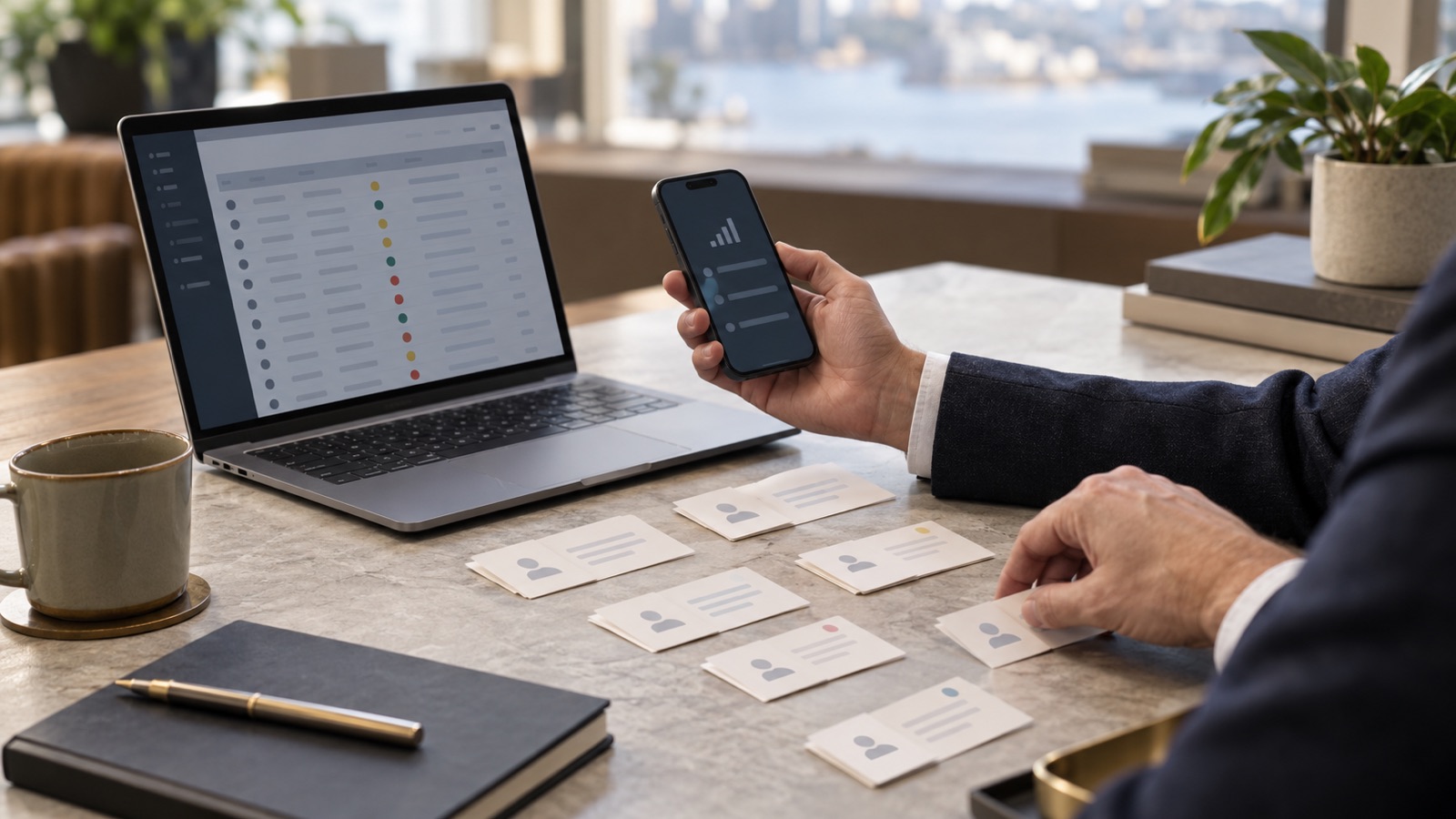
A trail book is not a readily serviceable client base merely because its loan balances and commission receipts reconcile. If borrowers cannot be contacted, client entities do not match loan records, or the files do not explain the advice history, the buyer may acquire income without the information needed to maintain relationships efficiently.
Test record quality before pricing the book. Measure valid contact channels, matching and completeness on de-identified data; inspect a controlled sample of files; then budget for verification, migration and remediation. Keep this operational test separate from the legal analysis of whether, when and how personal information and client communications may transfer.
Define what “contactable” means
A populated field is not proof of contactability. A mobile number may be malformed, shared, disconnected or associated with the wrong co-borrower. An email may bounce, belong to an old workplace or appear on several unrelated clients. A postal address may be years out of date.
Agree measurable statuses before reviewing the export:
- recently confirmed: the client verified the channel within a defined period;
- recently successful: the seller has evidence of a delivered email, completed call or other genuine interaction;
- present but untested: a value exists, but there is no current evidence it works;
- invalid or failed: bounced email, disconnected number, returned mail or recorded correction required; and
- missing or ambiguous: blank, incorrectly formatted, shared without context or linked to conflicting client records.
Preserve the verification date and evidence type. A “yes” column without provenance cannot distinguish last week’s successful call from a number imported ten years ago.
For organisations covered by the Australian Privacy Principles, APP 10 requires reasonable steps to ensure personal information collected is accurate, up to date and complete, and information used or disclosed is also relevant to its purpose. OAIC guidance identifies regular review, consistent formats, prompt updates and verification with the individual as possible steps (OAIC). That is a legal context for specialist advice, not a warranty that a seller’s database is reliable.
Request a record-quality evidence pack
Ask for a de-identified client-to-loan dataset and a data dictionary that explains every field, status and system of record. The pack should allow the buyer to test:
- unique client, household, loan and lender identifiers;
- primary and secondary borrower links, including company and trust borrowers where applicable;
- email, mobile and postal fields, with last-confirmed and last-successful-contact dates;
- active, discharged, refinanced and duplicate-record flags;
- lender and aggregator account references, without unnecessary personal identifiers;
- responsible broker or credit representative at origination and at the latest service event;
- last review, contact attempt, outcome, opt-out or do-not-contact marker and complaint flag;
- locations of the credit proposal, preliminary assessment, supporting documents, consents and material file notes; and
- exception logs from CRM migration, email delivery, returned mail and data cleansing.
Obtain record counts from the CRM, document system, aggregator statement and loan-level commission file. Differences are not automatically errors, because one client can have multiple loans and one household can contain several borrowers. They do require a documented mapping rule.
ASIC’s Regulatory Guide 273 says mortgage brokers are expected to keep records of how they acted when providing credit assistance, including inquiries into the consumer’s circumstances and consideration, investigation and assessment of recommended products. It lists records such as the responsible-lending assessment material, credit guide and credit proposal disclosure document (ASIC). A commission row alone therefore says little about whether a usable servicing file exists.
Reconcile people, entities, loans and responsible brokers
Build a four-way bridge rather than trusting one customer count:
- Client entity: individual, co-borrower, company or trust recorded in the CRM.
- Relationship group: household or commercial group used for servicing.
- Loan account: lender reference and status appearing in the trail file.
- Responsible history: originating broker, later servicing broker and relevant authorisation context.
Report one-to-zero and many-to-many exceptions. Examples include an active trail loan with no CRM client, one email reused across unrelated households, duplicate clients attached to the same account, a discharged loan still marked active, or a responsible broker field that cannot be traced through a migration.
Do not “fix” duplicates by automatically deleting one row. Compare names, historical addresses, lender references, contact notes and documents, then retain an audit trail of the merge decision. A duplicate may represent a co-borrower, a later application or a legitimately separate relationship.
Sample files without turning diligence into a data transfer
Start with aggregated and de-identified measures: completion rates, age bands for last contact, bounce rates, duplicates, unmatched records and file-document availability. OAIC’s guidance on selling a business says vendors should avoid giving prospective purchasers customer names and identifiers where possible, consider de-identification, and use controls such as confidentiality terms, restricted physical access or a limited-access data room. It also says a prospective purchaser should generally avoid collecting personal information and should destroy or return information collected after diligence (OAIC).
Have privacy counsel design any identifiable-file review. This article does not decide the lawful basis, consent, notice, disclosure or post-completion communication process; those matters belong in the transaction’s privacy workstream.
Use a stratified sample rather than only the seller’s “best” files. Include large and small balances, old and recent vintages, different lenders, responsible brokers, contact-age bands, companies or trusts, apparent duplicates and known exceptions. For each sampled file, score whether:
- the loan and borrowers match the trail data;
- at least one channel has evidence of recent success;
- key documents and material file notes can be located;
- changes to contact details are time-stamped and consistent across systems;
- the latest service event and responsible person are identifiable; and
- restrictions or exceptions are visible, rather than buried in free text.
Record the selection method, denominator, failure reason and unresolved evidence. Do not project a small sample mechanically across the whole book; use it to test the seller’s data-quality assertions and decide whether broader testing is needed.
Turn exceptions into cost and transaction protections
Create an exception register with owner, action, estimated minutes, external cost, dependency and due date. Remediation may include validating channels, resolving entity matches, scanning paper files, exporting notes, deduplicating records, correcting fields, obtaining missing material and building secure migration controls.
The OAIC’s APP 11 guidance says covered entities must take reasonable steps to protect personal information from misuse, interference, loss and unauthorised access, modification or disclosure. It describes technical and organisational measures, and treats outsourced records as held where the entity retains possession or control (OAIC). The remediation plan should therefore address security and access, not just spreadsheet cleanliness.
Use findings to shape price assumptions, conditions precedent, seller cleanup, warranties, a completion data specification and post-settlement assistance. Specialist lawyers should settle privacy, transfer and contractual protections; credit-compliance advisers should assess file obligations; technology specialists should test extraction and migration; and accountants or valuation advisers should decide how verified remediation costs and serviceability affect the buyer’s model.
Frequently asked questions
Is an email address and mobile number enough?
No. The buyer needs to know whose channel it is, when it was verified, whether recent attempts succeeded, whether it is shared, and whether restrictions or context apply. Presence, validity and permission are separate questions.
What is a useful record-quality percentage?
There is no universal pass mark. Define each field, denominator and evidence standard, then compare cohorts and model the consequences. A high overall completion rate can conceal weak records in the book’s largest balances or most valuable client groups.
Who should repair the records?
That is a negotiated allocation. The parties might require seller remediation before completion, exclude unresolved records, adjust price or fund a controlled post-completion project. The agreement should state the standard, evidence, responsibility, deadline and consequence of failure.
Related reading
- Mortgage broker trail-book acquisitions
- Buying a Mortgage Broker Trail Book: A Buyer’s Investigation Guide
- Trail-Book Due Diligence: Documents and Data Buyers Should Request
- How to Reconcile Trail Statements With Bank Receipts and Loan-Level Data
- Commission Rights, Servicing Rights and Client Relationships: What Transfers?
Sources
- Chapter 10: APP 10 Quality of personal information — Office of the Australian Information Commissioner, reviewed 2026-10-04
- Selling a business — Office of the Australian Information Commissioner, reviewed 2026-10-04
- Regulatory Guide 273 Mortgage brokers: Best interests duty — Australian Securities and Investments Commission, reviewed 2026-10-04
- Chapter 11: APP 11 Security of personal information — Office of the Australian Information Commissioner, reviewed 2026-10-04
Disclaimer
This article provides general information only. It does not constitute legal, tax, accounting, financial, credit, valuation or other professional advice. Circumstances differ. Obtain advice from appropriately qualified advisers before acting or entering a transaction.

